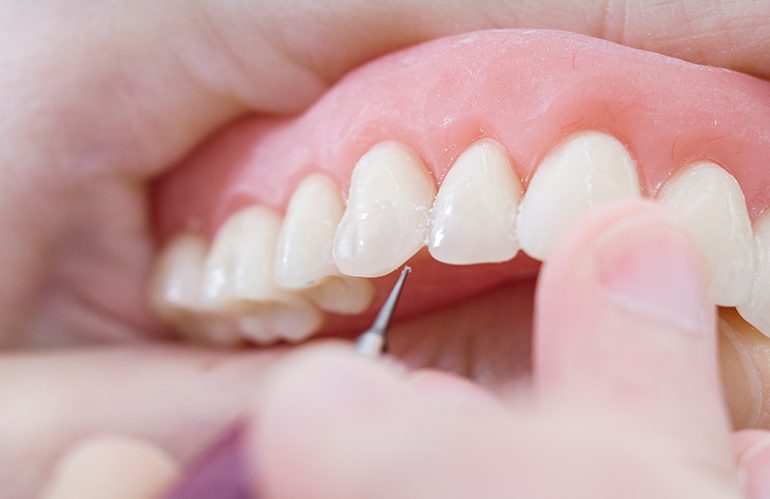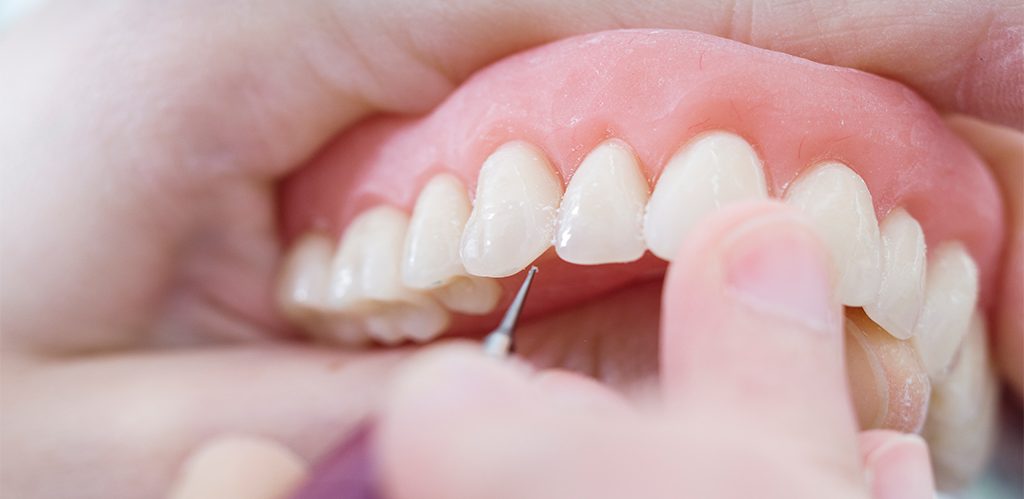
Tooth loss is not only a matter of appearance. A missing tooth makes chewing harder, can affect speech, causes the neighboring teeth to tilt towards the gap, and the jawbone in that area may lose volume over time. Making the right choice among the types of dental prostheses is the first step in preventing these consequences. As DijiDent Oral and Dental Health Polyclinic, in Türkiye we determine the prosthesis plan together with you according to your oral structure and your daily life.
How Are Prostheses Grouped?
The most basic distinction is whether or not the prosthesis stays fixed in the mouth. Fixed prostheses are cemented or screwed in; they cannot be removed by the patient. Removable prostheses, on the other hand, can be put in and taken out. As a third group, implant-supported solutions can be designed in either form.
Fixed Prostheses
- Crown (cap): A restoration that completely covers a single tooth. It is preferred for teeth with excessive structure loss, broken teeth or teeth that have undergone root canal treatment.
- Bridge: Closes the gap by taking support from the teeth on either side of the missing tooth. It is produced as a single piece. Its advantage is that it is fixed and the adaptation period is short; its disadvantage is the need to reduce the healthy neighboring teeth.
Removable Prostheses
- Partial denture: Applied in mouths where some teeth are present. It takes support from the existing teeth and the gums.
- Complete denture: Used in fully edentulous jaws. It relies entirely on the gums and bone structure. In the upper jaw it holds more easily thanks to the suction effect it gains from the palatal surface, while in the lower jaw retention is more difficult due to tongue movements.
Implant-Supported Prostheses
They take support from implants placed in the jawbone. For a single missing tooth, an implant-supported crown can be planned; for multiple missing teeth, an implant-supported bridge; and for full edentulism, a fixed full-arch prosthesis or a removable prosthesis supported by attachments. Their most important advantage is that there is no need to reduce the neighboring teeth.
Factors That Determine the Choice
- The number of missing teeth and the distribution of the gaps in the mouth
- The height and density of the jawbone
- Gum health and the condition of the existing teeth
- The bite relationship and teeth clenching habit
- Your general health condition and the medications you use
- Manual dexterity and cleaning habits
- Your aesthetic expectations and budget plan
None of these criteria is decisive on its own. For example, even if an implant is technically suitable, a different plan is designed if the patient does not want surgery. The decision is made together with you.
Temporary Prostheses
Temporary prostheses used until the permanent solution is prepared are also part of the plan. Especially with gaps in the front region, the patient does not have to take a break from social life. Temporary prostheses also preserve the shape of the gums and contribute to a better fit of the permanent prosthesis. These solutions are also frequently used during the healing period of implant treatment.
The Consequences of Postponing Tooth Loss
When a gap remains empty for a long time, the neighboring teeth tilt, the tooth in the opposing jaw elongates and the bone in the area loses volume. As these changes progress, the options narrow; an area that was initially suitable for an implant may require additional procedures years later. For this reason, we recommend that you do not postpone the evaluation of the missing teeth.
Staged Planning
In comprehensive cases, it is not always necessary to complete the entire treatment at once. The plan can be spread over time, starting from the priority area. For example, the back region that affects chewing the most is addressed first, and the aesthetic region is planned at a later stage. This approach both allows you to manage your budget and gives the opportunity to evaluate the result at each stage.
The Contribution of Digital Planning
At our clinic, we support the prosthesis plan with intraoral scanning data and, when necessary, three-dimensional imaging data. Bone measurements and the digital model allow the options to be compared concretely on screen. In this way, the decision is based not on an abstract explanation but on data you can see.
Frequently Asked Questions
The unbalanced distribution of the chewing load may lead to strain on the joint over time; an evaluation is recommended.
In general, there is no single best option; the best one is the one suitable for the case.
An implant or a bridge is evaluated. The condition of the neighboring teeth is decisive.
A difference may be felt in the first days; most people adapt within a short time.
What is decisive is not age but oral and general health condition.
Switching from some plans to others is possible; an evaluation is needed.
Do not postpone your missing teeth.
Contact us to book an appointment to find out which prosthesis option is suitable for your oral structure. Let us create your personalized plan together at DijiDent Oral and Dental Health Polyclinic.
This content is for general information purposes. The type of prosthesis and the treatment duration are determined according to the clinical examination and test results.