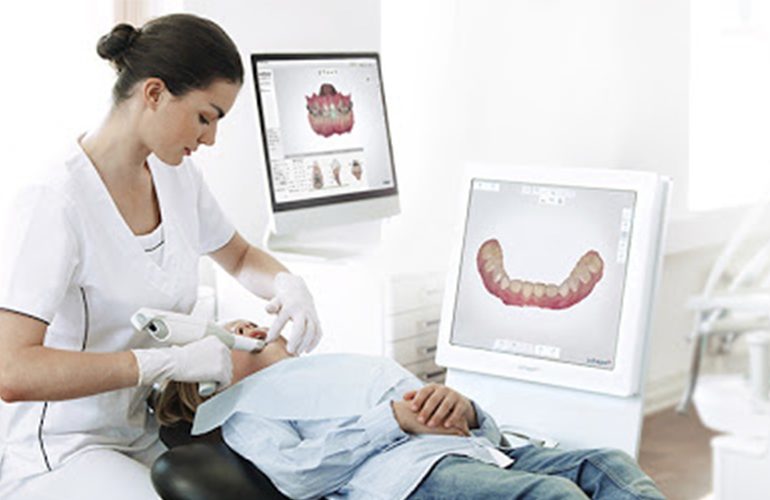
There are two ways to take an impression in dentistry: the traditional mold method and optical scanning. Both serve the same purpose: transferring the shape of your teeth and gums to the laboratory. However, they differ markedly in terms of patient experience and workflow. Knowing the differences between digital and conventional impressions makes it easier to understand the method recommended to you. As DijiDent Oral and Dental Health Polyclinic, in Türkiye we choose the method according to the case and the patient’s condition.
How Is a Conventional Impression Taken?
In this method, a paste-like material placed in a carrier called an impression tray is inserted into the mouth. A certain period of time is waited for the material to harden; during this time your mouth must remain closed and still. When hardening is complete, the mold is removed and a physical model is obtained in the laboratory by pouring plaster into it.
The greatest advantage of the method is that it is a well-known technique with many years of history and does not require a special device. In some clinical situations, for example when the borders of mobile tissue need to be recorded in completely toothless jaws, it may still be preferred.
Its Challenging Aspects
- The mouth must be kept closed during the waiting period.
- Significant discomfort may occur in people with a sensitive gag reflex.
- The material may deform while being removed from the mouth.
- The mold or plaster model may be damaged during transport.
- In the case of an inadequate impression, the entire procedure is repeated from the start.
The Difference of the Digital Impression
With an optical scanner, there is no paste and no waiting. During the scan you can pause whenever you want and swallow. If a missing area is detected, only that area is rescanned; there is no need to redo the entire procedure. Since the model is digital, the risk of deformation, breakage or loss is eliminated and transfer to the laboratory happens instantly.
The second important difference is archivability. Plaster models become impossible to store over time; digital records, on the other hand, can be used for comparison years later. The course of tooth wear or gum recession over time can thus be tracked objectively.
Cost and Accessibility
Digital scanners require a serious investment for the clinic; for this reason, they are not found in every clinic. However, from the patient’s point of view, the method itself is not the only factor that determines the treatment fee. The material to be used, the laboratory stage and the scope of the treatment are much more decisive. The choice of method should be made on clinical grounds, before cost concerns.
Accuracy Comparison
This is the topic our patients are most curious about. When applied correctly, both methods produce clinically acceptable results. In short-span measurements, for example for a single crown, the digital method gives strong results. In long-span measurements extending across the full arch, careful application of the scanning technique becomes important. In short, what is decisive is not the name of the method but the quality of application.
The Difference in Terms of Patient Experience
The most concrete difference between the two methods is the patient’s control over the process. In a conventional impression, after the material is placed in the mouth, the process enters a waiting period in which the patient cannot intervene; this feeling is the real source of discomfort in anxious patients. In digital scanning, you can stop, talk and continue whenever you want. This experiential difference is as important as the clinical result, because it reduces the tendency to abandon treatment halfway.
Which One Is Preferred in Which Case?
Digital impressions are widely used in applications such as crowns, bridges, implant-supported prostheses, clear aligners and night guards. In completely toothless jaws and in some prosthesis cases where the mobile tissue border needs to be recorded functionally, the conventional method or approaches in which both methods are used together may come into consideration. At our clinic, we share this decision with you and explain why we recommend that method.
Frequently Asked Questions
No. It is advantageous in most cases; however, in some prosthesis cases the conventional method may be preferred. The decision is made according to the clinical situation.
The impression is an important factor, but not the only one. Gum healing, the bite and the laboratory stages also play a role.
It usually takes less time and requires no waiting.
They are used. In certain indications, it is still a valid and reliable method.
Yes. In some comprehensive cases, a combined approach may be preferred.
Let us determine the impression method that suits you together.
If you have had difficulty with impressions before, be sure to share this; let us plan the process around you. Contact us to book an appointment; let us design a comfortable treatment experience at DijiDent Oral and Dental Health Polyclinic.
This content is for general information purposes. The choice of method is made by your dentist after the clinical examination.