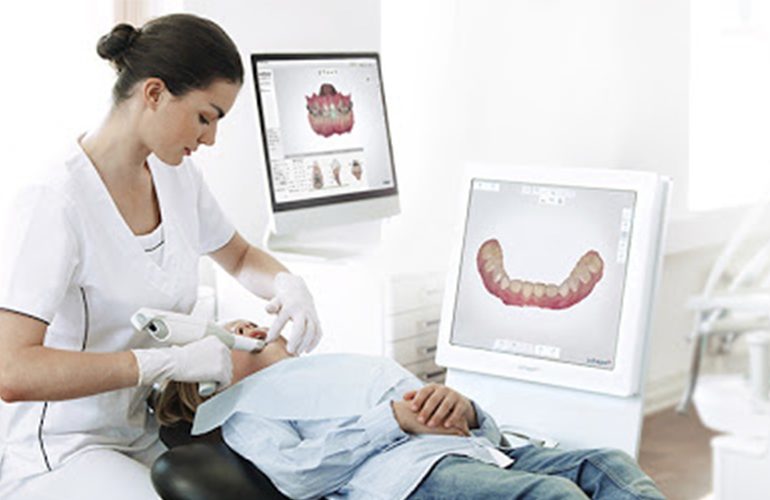
One of the most frequently asked questions when planning an appointment is the duration. Especially for our patients trying to squeeze treatment into a busy working day, this information is decisive. The intraoral scan duration is significantly shorter than that of a conventional impression; however, rather than giving a single figure, it is more accurate to explain the factors that affect the time. As DijiDent Oral and Dental Health Polyclinic, at our clinic in Türkiye we share your appointment time realistically from the start.
How Long Does the Scan Itself Take?
In an experienced application, scanning a single jaw is usually completed within a few minutes. A complete record requires three stages: the lower jaw, the upper jaw and the bite relationship between the two jaws. The total of these three stages fits into a short time frame for most patients. For comparison, in a conventional impression, even the time waited just for the material to harden is close to this.
What Does the Whole Appointment Include?
There is an important distinction here: the scan duration and the appointment duration are not the same thing. Your appointment covers the following steps:
- Examination and evaluation of your complaints
- Cleaning and drying of the tooth surfaces
- Completion of the scan in three stages
- Reviewing the model together on screen
- Discussing the plan and the next steps
For this reason, we recommend that you set aside time not just for the scan but for all of these steps.
Why Do We Not Give a Single Figure?
Definitive statements frequently encountered on the internet, such as “a digital impression takes two minutes,” often describe ideal conditions. In reality, the time varies according to the condition of your mouth, the area to be scanned and your personal tolerance. Giving a realistic range is a more correct approach so as not to surprise you at the appointment.
Factors Affecting the Duration
- Size of the area to be scanned: While a limited region may be sufficient for a single crown, the entire arch is scanned in full-arch planning.
- Visibility of the gum margin: If the crown margin lies below the gum, additional preparation is needed.
- Moisture control: Saliva accumulation slows the scan; drying is done from time to time.
- Patient cooperation: The ability to remain still and open the mouth sufficiently directly affects the duration.
- Gag reflex: If there is sensitivity, the scan is done in parts and the total time increases.
- Existing condition of the mouth: Orthodontic brackets, many restorations or mobile teeth can prolong the process.
The Effect of Experience
Scan duration depends largely on the experience of the person performing it. Following the correct scanning path, holding the device at the appropriate distance and angle and instantly noticing areas with data loss are skills that develop with practice. Two different operators using the same device on the same patient may obtain results in different times.
Duration in Child Patients
In children, scanning is usually done in shorter segments. Short breaks are given in between; although this slightly increases the total time, it ensures the procedure can be completed. The child having been prepared for the process is one of the most important factors affecting the duration.
Duration Compared with a Conventional Impression
In a conventional impression, the tray must be prepared, the material mixed, placed in the mouth and left to harden. If the result is inadequate, all these steps are repeated from the start. In digital scanning, only the missing area is rescanned. For this reason, the real time saving arises not in the first application but in situations that require repetition.
How Much Progress Can Be Made on the Same Day?
The approach we frequently plan for our patients coming from abroad or with limited time is this: the examination, three-dimensional imaging if necessary, and digital scanning are completed in the same session. In this way, all records are taken in a single visit and the planning process begins immediately. The application stages of the treatment are carried out in separate appointments.
Frequently Asked Questions
No. You can rest, swallow and take a break between stages.
No. If a missing area is detected, only that area is rescanned.
Usually yes; the most important difference is that there is no waiting time for hardening.
A short time is sufficient for the scan alone; however, we recommend setting aside additional time for the examination and evaluation.
The model is created immediately and reviewed together. For treatments requiring a laboratory stage, production time is planned separately.
Make the most of your appointment.
If you have limited time, let us know in advance; let us plan the examination, imaging and digital impression in the same session. Contact us to book an appointment; let us use your time well at DijiDent Oral and Dental Health Polyclinic.
This content is for general information purposes. Durations vary from person to person and by case; definitive planning is done by your dentist.