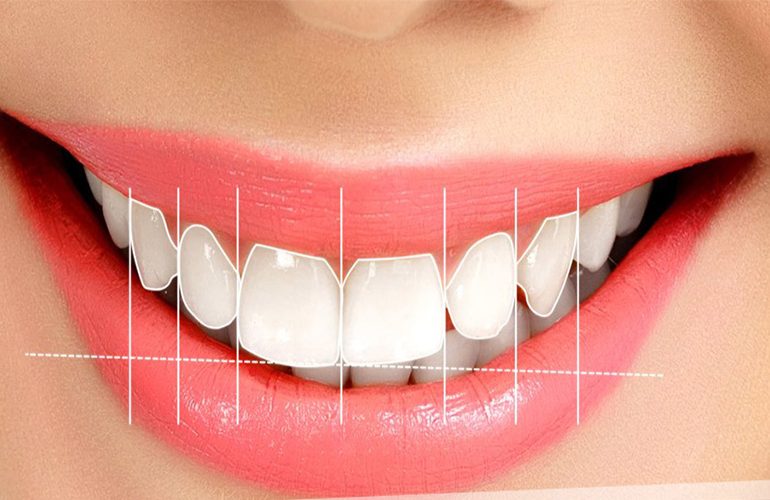
Most patients seeking aesthetic treatment come to the clinic thinking directly of crowns. For someone with crooked teeth, this seems like a quick solution. However, restorations made without correcting the position of the teeth often require more tooth tissue to be removed. When orthodontics and smile design are planned together, the result is more natural and your teeth are largely preserved. As DijiDent Oral and Dental Health Polyclinic, in Türkiye we carry out this evaluation at the first stage of planning.
Why Position First?
The position of a tooth and its form are different things. A tooth that is crooked, set back or rotated can be made to look “in line” by applying a restoration to its surface. However, to achieve this visual alignment, a significant amount of structure needs to be removed from the forward-facing part of the tooth. The further back the tooth sits, the more the preparation increases. In some cases, this amount can reach a level approaching the living tissue of the tooth.
Orthodontic treatment, on the other hand, moves the tooth instead of preparing it. A tooth brought into the correct position can reach the goal afterwards with a much more limited restoration, or without any restoration at all.
What Is the Concrete Benefit?
- The amount of preparation can decrease significantly.
- The likelihood of preserving the vitality of the tooth increases.
- The number of restorations can decrease; sometimes only a few teeth need them.
- Gum health is more easily maintained, because aligned teeth are cleaned better.
- The need for renewal can decrease in the long term.
Being Realistic About Duration
The greatest disadvantage of this approach is the duration. Orthodontic treatment lasts months and it may not always be possible to finish it by a special date. For this reason, some of our patients prefer direct restoration, and as long as it is made consciously, this is a decision to be respected. Our responsibility is to clearly explain the consequences of both options: the quick solution can mean greater loss of tooth tissue.
Can Partial Orthodontics Be a Middle Path?
In some cases, instead of a treatment covering all the teeth, the aim may be to correct only a limited irregularity in the front region. This approach can shorten the duration. However, it is not suitable in every case; if there are bite problems, limited treatment will not be enough and the permanence of the result is put at risk. Suitability is determined by orthodontic evaluation.
An Invisible Gain: The Bite
Orthodontic preparation has another benefit besides aesthetics. When the teeth come into the correct position, chewing forces are distributed evenly. The load on the restorations decreases and the risk of fracture drops. Aesthetic applications done in a mouth with a faulty bite can be damaged earlier than expected, however carefully they are made. For this reason, the aesthetic plan is concerned not only with appearance but also with function.
Can It Be Applied to Adults?
Yes. As long as gum and bone health are adequate, tooth movement can be achieved in adults. However, there is an important condition here: applying orthodontic force while there is active gum disease can accelerate bone loss. For this reason, a periodontal evaluation must be carried out before orthodontics. In patients with gum recession, whether the planned movement will push the bone boundaries is examined in advance.
How Is the Sequence Established?
The general flow is as follows: first caries and gum treatments, then orthodontic alignment, then adjustment of the gum level if necessary, followed by whitening and finally restorative applications. It is important that whitening is done before restoration, because porcelain and composite are not affected by whitening; for this reason, the shade decision must be finalized beforehand.
Frequently Asked Questions
Temporary changes in appearance during the interim periods of treatment are normal; this shows that the plan is progressing.
They can be corrected visually; however, this may require more preparation. Suitability depends on the case.
It is important that work is done on the same plan. Even if different dentists are involved, the goal must be determined jointly.
No. In many cases, no additional procedure may be needed after alignment, or a limited application is sufficient.
In suitable cases, yes. Fixed treatment may be preferred for complex movements.
The orthodontic stage can take months depending on the case. The exact duration is shared after evaluation.
A periodontal evaluation is needed first. Suitability is determined accordingly.
Get an orthodontic evaluation before deciding on crowns.
Let us examine together whether a plan that preserves your teeth is possible. Contact us to book an appointment; let us compare your options at DijiDent Oral and Dental Health Polyclinic.
This content is for general information purposes; the treatment option and durations vary from person to person. The decision is made with a dentist’s examination.