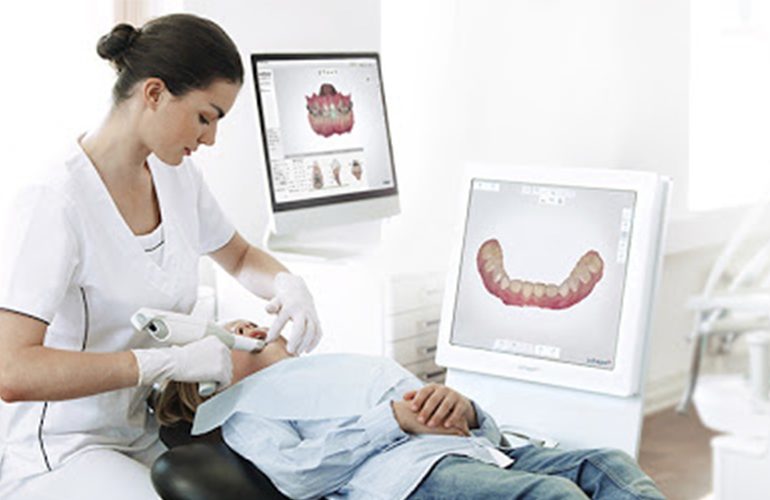
The expression CAD/CAM that you frequently hear at dental clinics is actually an abbreviation of two separate stages: computer-aided design and computer-aided manufacturing. For patients, this term usually remains abstract; however, it allows you to understand which steps of your treatment proceed and how. CAD/CAM dentistry moves the chain extending from impression to production into the digital environment. As DijiDent Oral and Dental Health Polyclinic, at our clinic in Türkiye we care about explaining this process to our patients in plain language.
What Do CAD and CAM Mean?
CAD — The Design Stage
The model obtained with a digital impression is transferred to the design software. Here, the form of the crown, bridge or prosthesis is created. The margin is determined, the relationship with neighboring teeth is adjusted and occlusal contacts are checked. At this stage, the technician and the dentist can work on the same model.
CAM — The Production Stage
The approved design is sent to the production unit. Two basic methods are used. In milling, the desired form is cut from a ready-made block; it is common in zirconia and ceramic restorations. In three-dimensional printing, the material is built up layer by layer; models, temporary restorations and surgical guides can be produced this way.
What Changes for the Patient?
- Reproducibility: Since the same design is saved, the process becomes easier when renewal is needed.
- Measurement-based control: Thickness and marginal fit can be checked numerically.
- Predictable production: The behavior of the material is calculated with known parameters.
- Archive: Your records can be used as a reference years later.
- Communication: It becomes possible to approve the design by seeing it on screen.
Is Machine Production Better Than Handcraft?
This is a question our patients frequently ask and one that cannot be answered in a single word. Digital production is strong in terms of reproducibility and measurement precision. On the other hand, in the aesthetic zone, details such as color transitions, translucency and surface texture still depend to a significant extent on the manual skill of the dental technician. In practice, most clinics use both together: the substructure is produced digitally and the aesthetic layers are worked by hand. In other words, it is not a matter of competition but of complementarity.
How Does Material Choice Affect the Process?
The materials that can be used in digital production behave differently from one another. Zirconia offers high durability and is frequently preferred in posterior restorations. Glass ceramics stand out in the aesthetic zone with their light transmission. Composite-based blocks are used for temporary purposes or in certain indications. Which material will be chosen is determined according to the position of the tooth, the amount of remaining tooth tissue, bite forces and your aesthetic expectations.
Is a Crown Possible in a Single Session?
In some centers with an in-clinic production unit, it may be possible to complete the restoration on the same day in selected cases. However, it would not be right to say that this can be applied to every patient and every restoration. In work covering many teeth, cases requiring shade matching in the aesthetic zone and situations where gum healing is awaited, the process naturally takes longer. At our clinic, we prefer to share a realistic timeline on this matter.
The Long-Term Value of Digital Records
Storing design files provides a concrete advantage to the patient. If your crown breaks or needs to be renewed years later, the previous design can be used as a reference. This both shortens production time and helps preserve the form you liked before.
Is Technology Alone Enough?
No. CAD/CAM is powerful when it works with the right data. If the impression is inadequate, the gum margin is not visible or the bite record is incorrect, the result will be ill-fitting no matter how precise the production is. For this reason, what is really decisive is not the device but the clinical evaluation and quality of application. When choosing a clinic, the question to ask should not be “which device do you have” but “how is the process carried out.”
Frequently Asked Questions
No. Some clinics carry out design and production through contracted laboratories; this is also a common and valid method.
Crowns, bridges, inlays-onlays, laminates, implant superstructures, temporary restorations and various guards and aligners can be produced.
The main factors determining the fee are the material, the scope of the restoration and laboratory craftsmanship. The method alone is not decisive.
Due to its structure, zirconia is produced by milling from blocks; for this reason, a digital production process is used.
In many cases, it is possible. You can request it from your dentist.
As in every process, there are control stages here as well. The try-in and approval steps are not skipped for this reason.
Make your decision knowing how your treatment will be produced.
Find out which method is suitable for your planned restoration and the estimated time. Contact us to book an appointment; let us explain the process from start to finish at DijiDent Oral and Dental Health Polyclinic.
This content is for general information purposes. Method and material selection are determined by your dentist after the clinical examination.