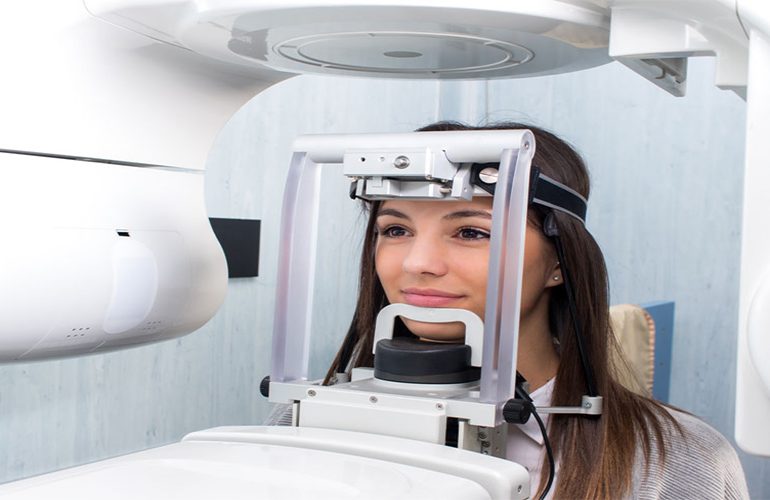
The question patients most often ask in lower jaw surgery is this: “Will my lip become permanently numb?” The source of this concern is the nerve that passes through the lower jawbone and provides sensation to the lower lip and chin skin. Knowing in advance the relationship between the mandibular nerve and the surgical site is the most concrete way to manage the risk. As DijiDent Oral and Dental Health Polyclinic, in Türkiye we base planning in such cases not on guesswork but on measurement.
Where Is This Nerve Located and What Does It Do?
The nerve, which runs inside the lower jawbone along a tunnel called the mandibular canal, carries the sensation of the lower teeth and surrounding tissues. The course of the canal varies from person to person; in some patients it runs more superficially, in others deeper. In addition, as bone height decreases with age and after tooth loss, the canal may become relatively closer to the surgical area.
This nerve is different from motor nerves; that is, damage to it does not cause facial paralysis. If it is affected, the picture seen is a change in sensation in the lower lip and chin: it is described as numbness, tingling or loss of sensation.
Why Are Individual Differences Important?
Anatomical variation is the rule itself in dentistry. In some patients the canal may split in two, in others it may run higher than expected. Proceeding on the assumption “the nerve is here” based on general anatomical knowledge is therefore not considered a safe approach. Seeing your anatomy is more valuable than relying on a statistical average.
How Is Mapping Done?
In three-dimensional imaging, the course of the canal is marked across the slices to create a virtual line. This process is called mapping. The following measurements are then made:
- The distance of the impacted tooth’s roots to the canal and whether they are in contact
- From which direction the root surrounds the canal (tongue side, cheek side or passing between)
- The safe bone height above the canal in the area where the implant is planned
- Whether the integrity of the canal wall is preserved
These measurements directly determine the surgical technique. For example, if the roots of an impacted tooth have wrapped around the canal, removing the tooth by sectioning may be preferred over removing it in one piece. In implant planning, the implant length is chosen taking into account the safety margin that needs to be left above the canal.
Alternative Approaches
In some impacted tooth cases where the risk is judged to be high, a selective technique may come into consideration in which, instead of removing the entire tooth, only the crown part is removed and the roots are left in place. The suitability of this approach is determined according to clinical and radiological findings; it is not preferred in every case. The aim is not to move roots close to the nerve unnecessarily.
The Lingual Nerve and Other Structures
This nerve is not the only structure taken into account in lower jaw surgery. The nerve that provides sensation to the tongue runs close to the inner surface of the lower jaw and is protected during surgery through the soft tissue approach. Since this structure does not run inside the bone, it cannot be directly followed on imaging; its protection depends on surgical technique and experience. In addition, depressions on the inner surface of the lower jaw and vascular structures are also taken into account in planning. Three-dimensional imaging allows these anatomical variations to be noticed in advance.
What Happens If a Change in Sensation Occurs?
After surgery, a temporary change in sensation may be seen due to tissue edema and manipulation and in most cases subsides over time. Permanent cases are rare. If you experience such a complaint, it is important to inform your clinic instead of waiting on your own; it needs to be followed up and, if necessary, referred. Your dentist explaining this possibility to you from the start is not bad news, but a natural part of the informed consent process.
Frequently Asked Questions
It can be extracted. Proximity does not mean the procedure is impossible; it shows that the approach needs to change.
In temporary cases, the duration varies from person to person. Follow-up is recommended; if your complaint persists, be sure to report it.
No. If there is no risk sign on the panoramic film, it may not be needed. Three-dimensional evaluation is requested in suspicious cases.
This risk is managed by leaving a safety margin during planning. For this reason, measurement is given importance in lower posterior implants.
You can ask about the tooth’s distance to the canal, the planned technique, the possibility of a change in sensation and the follow-up process. These questions are answered openly at our clinic.
Talking about the risk is the first step to managing it.
If you are planning an impacted tooth procedure or a lower jaw implant, let us evaluate your nerve proximity with three-dimensional imaging. Contact us to book an appointment; let us explain the plan along with the findings at DijiDent Oral and Dental Health Polyclinic.
This content is for general information purposes. Surgical risk assessment and technique selection are carried out by your dentist after the clinical examination and radiological examination.