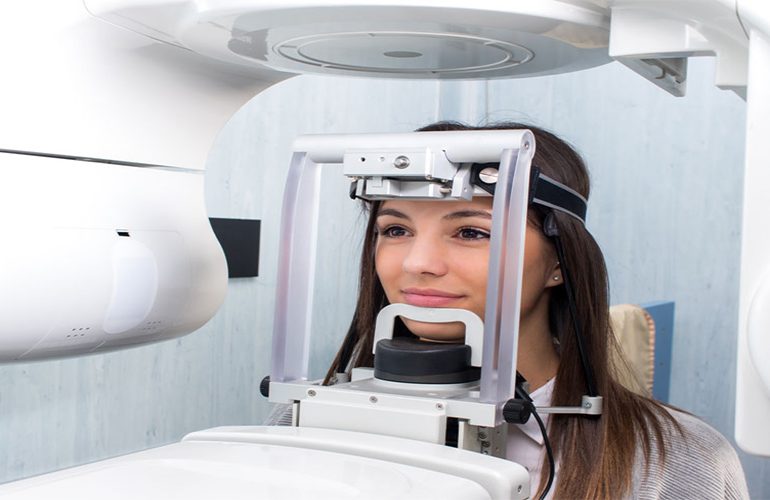
The concern our patients most often raise before imaging is radiation, and this concern is not unfounded; every medical imaging decision should have a justification. However, for the concern to rest on a sound basis, concrete information is needed. Dental tomography radiation dose often presents a different picture than is commonly assumed. As DijiDent Oral and Dental Health Polyclinic, in the imaging services we offer in Türkiye, we make every practice that reduces dose part of our standard workflow.
How Is Radiation Dose Evaluated?
In medical imaging, exposure is measured with a value called the effective dose, expressed in microsieverts (µSv). The key point to understand here is this: all of us constantly receive radiation from natural sources in daily life. This exposure, originating from the soil, building materials, food and cosmic rays from space, is called natural background radiation. The dose of medical imaging is usually explained in terms of how many days of this natural background it corresponds to, because it offers a meaningful comparison instead of an abstract number.
Where Do Imaging Methods in Dentistry Stand?
The general ranking is as follows: a single-tooth film (periapical) is the lowest-dose imaging. The panoramic X-ray is above it. Cone beam computed tomography (CBCT) uses a higher dose than panoramic. On the other hand, the dose of CBCT is significantly lower compared to conventional medical computed tomography taken in a hospital setting. Exact values vary depending on the device model, the selected resolution and the size of the imaging field; for this reason, giving a single figure would not be correct.
What Is the ALARA Principle?
ALARA is an international radiation safety principle meaning “as low as reasonably achievable.” Its practical meaning is simple: using the lowest dose sufficient to obtain the information required for diagnosis. This principle translates into three concrete steps.
- Justification: Imaging is requested if it will change the treatment decision. Not as a routine habit.
- Optimization: The imaging field is limited only to the region of interest, and the resolution is selected according to clinical need.
- Protection: Protective equipment is used where appropriate and unnecessary repetitions are avoided.
At DijiDent, we apply all three of these steps. We specifically ask our patients to bring their existing images, because there is no clinical justification for repeating the examination when a current and adequate image exists.
Why Is Reducing the Imaging Field Important?
In CBCT devices, the volume to be imaged can be adjusted. If a single impacted tooth is to be evaluated, there is no need to image the entire jaw. Narrowing the field both reduces the dose and increases image resolution, providing a clearer evaluation. Although this may seem like a technical detail, it is a choice with direct consequences for patient safety.
Who Requires Extra Care?
Children and young people are considered more sensitive to radiation than adults because of their developing tissues. This does not mean that imaging cannot be done in children; however, it requires the indication to be evaluated more meticulously and the dose to be kept at the lowest possible level. In the case of pregnancy, elective imaging is postponed if possible. In our patients with a history of oncological treatment, the current situation is evaluated taking into account the opinion of the relevant specialist physician as well.
For this reason, it is very important that you inform us before the examination about the possibility of pregnancy, the treatments you have undergone and any images taken recently. This information allows us to choose the safest path for you.
Frequently Asked Questions
The individual risk of a single dental imaging procedure is considered very low. Nevertheless, every examination should be justified and unnecessary repetitions should be avoided; this is the basis of the scientific approach.
There is no fixed number. What is decisive is that each scan is clinically necessary. As long as there is no unnecessary repetition, the imaging required during the course of treatment can be done.
The use of protective equipment is determined according to the features of the device and current radiation safety recommendations. You can get detailed information from your dentist about the protocol applied at our clinic.
Dental imaging is not considered a procedure that affects breast milk. Nevertheless, it is recommended that you inform your dentist of your situation and make the decision together.
If the image is current, of adequate quality and covers the relevant region, it can be used. This is the most practical way to prevent unnecessary exposure.
Do not hesitate to ask your questions; information is the first step to trust.
Contact us to book an appointment to find out whether imaging is necessary for you and which method will provide sufficient information at the lowest dose. Let us plan the process together transparently at DijiDent Oral and Dental Health Polyclinic.
This content is for general information purposes. Dose values vary according to the device and protocol; the imaging decision is made by your dentist.