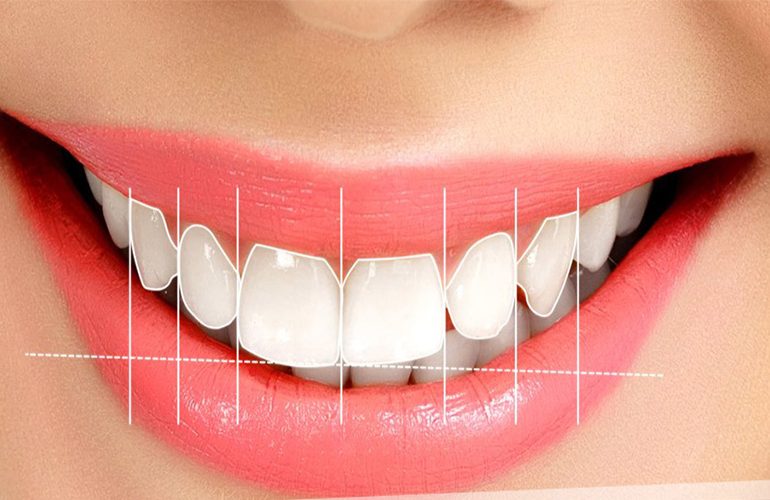
Most people can tell at a glance whether a smile looks natural or artificial; however, they struggle to describe why. In fact, there are measurable relationships behind this perception: the proportions of the teeth to one another, their lengths, surface textures and the relationship they form with the lips. Natural tooth proportions form the technical basis of aesthetic planning. As DijiDent Oral and Dental Health Polyclinic, in Türkiye we build the design with these criteria, but without applying the same template to every patient.
Basic Criteria Used in Aesthetics
Width-to-Length Ratio
In the upper front incisors, the ratio of width to length is one of the most decisive criteria of a natural appearance. When this ratio falls outside a certain range, the tooth is perceived as either too square or too long. In worn teeth, because the length has shortened, the tooth looks square; this is the technical equivalent of patients saying “my teeth look like they’ve aged.”
Visual Proportion Between Teeth
Viewed from the front, there is a gradual decrease in the visible widths of the central incisor, lateral incisor and canine. When this gradation is disrupted, the smile is perceived as artificial. In the literature, references such as the golden ratio are used for this relationship; however, these are a starting point, not unchangeable rules.
Gum Level
A certain harmony is expected between the gum margins of the incisors and canines. A tooth’s gum margin being noticeably different makes the smile look unbalanced even if the teeth are flawless.
Why Do Teeth Look Artificial?
- Excessive symmetry: In natural teeth, the right and left are not exactly the same. Perfect symmetry disturbs the eye.
- Uniform form: All teeth having the same form and the same width.
- Loss of surface texture: Natural enamel has fine lines and slight roughness; a completely smooth surface is perceived as artificial.
- Lack of translucency: Natural teeth have slight translucency at the incisal edges.
- Excessive whiteness: A shade that does not match the skin tone and the whites of the eyes makes the smile stand out but reduces naturalness.
- Length that does not suit the person: A length that does not match age and facial proportions.
The Incisal Edge Line
When the line formed by the incisal edges of the upper front teeth is in harmony with the curve of the lower lip, the smile is perceived as balanced. When this line becomes a straight line, the smile looks harsh and artificial; this is the situation most often encountered in worn teeth. In a natural smile, the central incisors are somewhat longer than the lateral incisors and the canines protrude slightly.
Are the Proportions the Same for Everyone?
No, and this is the most important point. The criteria offer a starting framework; the final decision is made according to your facial proportions. Face length, lip mobility, smile width and age affect this decision. While more prominent incisal edges are natural in a young patient, preserving slight wear at an older age can increase the credibility of the result. Applying the same form to everyone is the main reason a smile stops belonging to the person.
Differences by Gender
As a general tendency, more rounded contours and soft transitions may be preferred in female patients, while more pronounced corners and straight incisal edges may be preferred in male patients. However, these are tendencies, not rules. What is decisive is your expectations and your facial features.
How Should You Describe Your Expectations?
Verbal descriptions are understood differently by different people. Showing examples of smiles you like and dislike is the most effective way for the design to proceed in the right direction. Your old photographs are also valuable; your own tooth form before wear can be a strong reference in determining the goal.
Frequently Asked Questions
Yes, we recommend it. Your own tooth form before wear can be a strong reference in determining the goal.
In some cases it may be possible with restorations, in others by adjusting the gum level. Evaluation is needed.
A single-tooth restoration is possible; however, achieving color and form harmony is evaluated together with the neighboring teeth.
It is used as a reference; however, it is adapted to your facial proportions.
Shades that do not match skin and eye color can be perceived as artificial. The shade is chosen together.
It can be evaluated with composite, restoration or an orthodontic approach. The option is determined by examination.
No. Slight asymmetry supports a natural appearance.
A smile that belongs to you is possible with proportions adapted to you.
Contact us to book an appointment to have a design prepared that suits your facial features. Let us turn your expectations into a measurable plan at DijiDent Oral and Dental Health Polyclinic.
This content is for general information purposes; aesthetic results vary from person to person. Planning is done with a dentist’s examination.