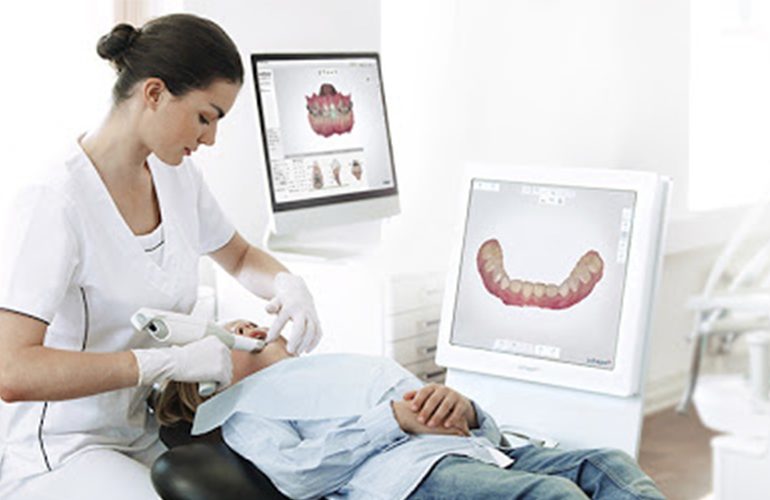
An intraoral scanner is not a device specific to a single treatment; it is the shared infrastructure of the modern clinic. The same data is used when a crown is planned for one patient, clear aligner treatment for another and an implant-supported prosthesis for yet another. For this reason, the areas of use of digital impressions are quite broad. As DijiDent Oral and Dental Health Polyclinic, at our clinic in Türkiye we bring this data into play at whichever stage of treatment it is needed.
Fixed Restorations
In restorations such as crowns, bridges and inlays-onlays, marginal fit is decisive. A small gap at the line where the crown meets the tooth can, over time, pave the way for plaque accumulation and gum problems. In a digital impression, this margin can be checked by magnifying it on screen; if it looks inadequate, that area is rescanned immediately. Zirconia and all-ceramic restorations can be integrated directly into the digital workflow extending from design to production.
Orthodontic Applications
Clear Aligner Treatment
All custom-made clear aligners are designed on the digital model. The scan data forms the basis of the treatment simulation; where the teeth will move at which stage is planned on this model.
Retainers and Appliances
Retainers used after treatment and some orthodontic appliances can be produced with a digital impression. In addition, by superimposing the scan at the start of treatment with the current scan, tooth movements can be tracked visually.
Use for Diagnosis and Planning
Scanning is not just a production step; it is also used as a diagnostic tool. Examining the bite relationship digitally helps evaluate which teeth make early contact and how chewing force is distributed. This information can be a guide in understanding the source of the problem in patients who complain of teeth clenching or whose restorations frequently break.
Implant and Prosthesis Applications
In implant-supported prostheses, scan data is combined with three-dimensional tomography, allowing prosthetically driven planning. Surgical guide production is also made possible by merging these two data sets. For removable prostheses, while the digital method can be used in some cases, the conventional method or a combined approach may be preferred in completely toothless jaws.
Temporary Restorations
Temporary crowns and bridges used until the permanent restoration is ready can also be designed and produced on the digital model. This allows you to wait with a well-fitting and comfortable solution even during the temporary period; it is also important for maintaining gum health.
Protective and Follow-Up Use
- Night guard: Production of a custom guard for patients with teeth clenching and grinding habits.
- Sports guards: Preparation of mouthguards used in contact sports.
- Wear monitoring: Numerical comparison of loss of tooth structure over the years.
- Gum recession monitoring: Objective tracking of changes in the level of recession.
- Whitening trays: Production of custom trays used in at-home whitening.
Integration with Smile Design
In digital smile design, scan data is combined with photo and video records. In this way, the planned tooth form can be evaluated by placing it over the existing teeth, and the trial (mock-up) stage is prepared on this model.
Use in Patient Information
A frequently overlooked benefit of the digital model is communication. Seeing the inside of your mouth magnified on screen allows you to grasp concretely the problem your dentist is describing. A worn tooth surface, a receded gum margin or an area suspected of a crack remains abstract when described in words but is seen clearly on screen. This supports your informed participation in treatment decisions.
Is It Used in Every Case?
No. Scanning is not done for procedures that do not require an impression, such as a simple filling or root canal treatment. We also mentioned that the conventional method is more suitable in some prosthesis cases. The right approach is not to use technology in every case but to use it where it is needed.
Frequently Asked Questions
It is not needed for conventional fillings. It is used in laboratory-produced restorations such as inlays-onlays.
In many cases it is sufficient and is a comfortable option.
It varies by case. In some treatments, initial, interim check and final scans may be taken.
If the file format is compatible, it can be used. Your records are shared upon request.
In some cases, yes; however, in completely toothless jaws the conventional method may be preferred.
Find out how the digital workflow will be used in your treatment.
If you are planning a crown, clear aligners, a night guard or an implant-supported prosthesis, let us design the process together from the start. Contact us to book an appointment; let us determine the method that suits you at DijiDent Oral and Dental Health Polyclinic.
This content is for general information purposes. The method to be used is determined by your dentist after the clinical examination.