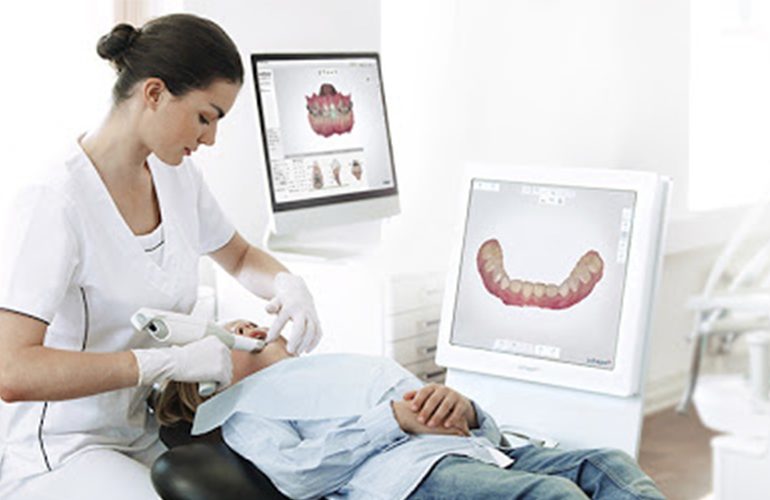
What emerges when an intraoral scan is completed is not a physical mold but a data file. This file is part of your health record and, when stored correctly, can be useful even years later. The points patients most wonder about regarding a dental scan file are these: where is this file kept, can it be given to me, and can it be used at another clinic? As DijiDent Oral and Dental Health Polyclinic, we give our patients in Türkiye clear answers to these questions.
In Which Formats Is a Scan File Stored?
Digital models are usually saved in several standard formats. The most common is the STL format; it contains only surface geometry, carries no color information and can be opened in almost any design software. PLY and OBJ formats also contain color information; they are preferred in aesthetic work and patient communication. In addition, each device manufacturer has its own proprietary format; since these formats contain the raw data and scan history, they can usually only be opened in the same system.
Which Format Should You Request?
If you are considering transfer to another clinic or laboratory, requesting it in open formats (STL or PLY) is the most practical way. A proprietary format can be restrictive, since it can only be opened at a center using a system of the same brand.
Where Is the File Stored?
Clinics usually keep scan data in two places: on local servers or computers and in cloud-based systems. Cloud systems make sharing between different centers easier. Whichever method is used, it is critical that the data is backed up; a record kept in a single copy can be lost in the event of a hardware failure.
Protection of Personal Data
Scan files fall within the scope of personal health data. First name, surname, date of birth and treatment information may be included in the file metadata. For this reason, storage and sharing are carried out within the framework of the legislation on the protection of personal data. At DijiDent, your data is processed for treatment purposes; it is not shared with third parties without your explicit consent. You also have the right to request that your file be deleted; however, legal retention periods may limit this request.
How Is Sharing Done?
- Secure link: Since file sizes can be large, they are usually shared via a download link.
- Cloud platforms: Manufacturer platforms can be used for transfers between clinics.
- Physical media: A USB stick or external disk is a rarely preferred method.
- Direct laboratory transfer: For production, the file is sent directly to the laboratory.
Since it is personal health data, it is recommended that the file not be shared carelessly via open messaging apps.
File Size and Backup
A scan file for a single jaw can range from a few megabytes to a few hundred megabytes depending on the format and resolution used. Formats containing color information take up more space. When keeping your own copy, using cloud storage or an external disk is safer than keeping it in a single place. Adding the scan date to the file name makes it easier to understand later which record belongs to which time.
The Practical Benefits of Keeping Your File
Having a copy on hand has concrete benefits. When your retainer is lost, a new one can be produced from the archived model. When you change clinics or countries, your new dentist can see your initial state. An evaluation can be made when getting a second opinion. When you notice a change in your teeth years later, the old model becomes a comparison reference.
Can I Open the File Myself?
Formats such as STL and OBJ can be opened with free three-dimensional viewers, and you can examine the model by rotating it. However, you are not expected to make a clinical interpretation; the aim is for you to be able to pass the data on to a dentist. Being unable to open the file does not mean the data is corrupted.
Frequently Asked Questions
You can request it; however, the legal retention periods set for health records may limit this request.
Yes. You have the right to access your own health data; simply contact your clinic.
If it was shared in an open format, it can usually be used. However, how current it is will be evaluated by the dentist.
The retention period is determined according to the relevant legislation. It is recommended that you get your own copy.
If there have been changes in your mouth, a current scan is needed. The old record is valuable for comparison.
In treatments requiring production, yes; it is shared for treatment purposes and within the framework of the legislation.
Your records are yours; keep a copy with you.
Contact us to request your scan files or to find out whether your existing records can be used in your current treatment. As DijiDent Oral and Dental Health Polyclinic, we carry out the process transparently.
This content is for general information purposes. Data storage and sharing processes are carried out within the framework of the relevant legislation.