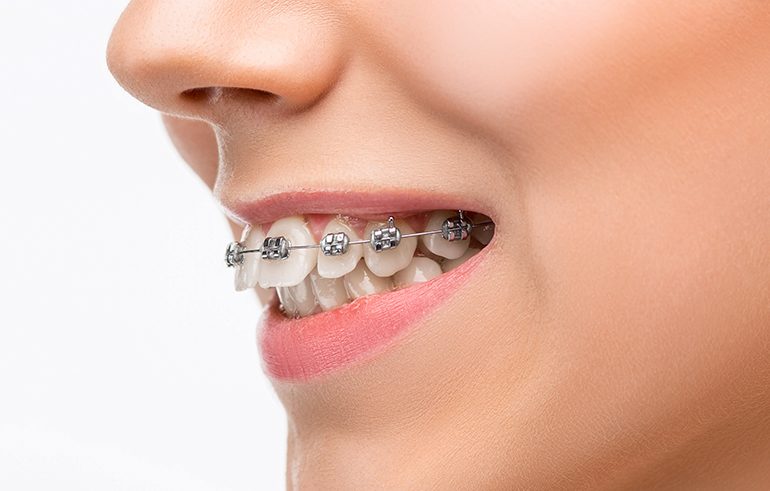
The aim of orthodontic treatment is straight teeth; however, protecting the health of the teeth while reaching this goal is at least as important as the alignment. In a mouth with brackets and wires, cleaning becomes more difficult and, when neglected, can leave permanent marks. Cleaning braces is the most critical daily responsibility of the treatment. As DijiDent Oral and Dental Health Polyclinic, in Türkiye we explain this topic in detail at the start of treatment.
Why Is It So Important?
A bracket creates new areas on the tooth surface where plaque can adhere. When this plaque is not removed, bacteria produce acid and mineral loss begins on the enamel surface. As a result, chalky white spots appear around the bracket. These are early caries lesions and become visible after the braces are removed.
The most frustrating aspect of this situation is this: the treatment is completed successfully and the teeth are aligned; however, permanent marks remain on their surfaces. For this reason, care is as important as the treatment.
Tools That Should Be Used
- Orthodontic toothbrush: With its notched middle design, it grips the area around the brackets better.
- Interdental brush: It reaches under the brackets and the wire; it is the most critical tool.
- Superfloss or floss threaders: Threaded under the wire to reach between the teeth.
- Water flosser: It complements mechanical cleaning; it does not replace it.
- Fluoride toothpaste: It helps support enamel resistance.
- Small mirror: To check areas that are missed.
Brushing Technique
First place the brush at an angle on the upper edge of the brackets and clean with small circular movements, then do the same for the lower edge. Do not skip the gum line; this area is the most frequently neglected one. Brushing after every meal is recommended; if this is not possible, at least rinse the mouth with plenty of water.
Time is also important. In a mouth undergoing orthodontic treatment, brushing takes longer than usual. Rushed brushing is not enough to clean around the brackets.
Gum Swelling
Gum enlargement and bleeding may be seen during treatment. The main cause of this is plaque accumulation; inflammation around the brackets causes the tissue to swell. Swollen tissue is harder to clean, and a vicious circle forms.
In this case, the solution is not to reduce brushing but to continue it with the right technique. Bleeding is usually a sign of inflammation and decreases within a few days with regular cleaning. If the swelling is pronounced and persistent, professional cleaning and a periodontal evaluation are needed.
Professional Cleaning
In patients undergoing orthodontic treatment, professional cleaning intervals are planned closer together. At check-up appointments, the gum condition is evaluated and cleaning is done when necessary. This does not replace home care; it complements it.
Fluoride Support
In patients undergoing orthodontic treatment, supporting enamel resistance becomes important. Using fluoride toothpaste is the basic step; your dentist may recommend additional applications according to your risk level. This support does not replace correct brushing; it complements it. Especially in patients who show a tendency to white spots around the brackets, this issue is evaluated separately.
For Clear Aligner Users
Since the aligners cover the teeth, in a mouth where they are put in without brushing, food residue and sugar remain in contact with the tooth surface for a long time. This significantly increases the risk of caries. You need to brush your teeth after every meal and then put the aligner in. The aligners themselves should also be cleaned regularly.
For Parents
In child and adolescent patients, care supervision is more effective with the support of the family. Checking the result rather than doing the brushing is a healthier approach; whitish deposits remaining around the brackets can be seen with the naked eye. Plaque-disclosing tablets can also be used from time to time to show the areas that have been missed. Showing rather than criticizing makes it easier for the habit to take hold.
Frequently Asked Questions
If your dentist recommends it, it can be supportive; however, it does not replace brushing and interdental cleaning.
In the early period, their progression can be stopped with fluoride applications; additional treatments are considered for marks that have already formed.
Yes. The brush cannot reach between the teeth; products that can be threaded under the wire are used.
No. It is complementary; mechanical cleaning is essential.
No. Bleeding is usually a sign of inflammation; cleaning should continue with the right technique.
It is usually suitable; models with orthodontic heads can be preferred.
Our goal is healthy teeth as much as straight teeth.
If you are struggling with care or your gums are swollen, do not neglect your check-up. Contact us to book an appointment; let us review your care program at DijiDent Oral and Dental Health Polyclinic.
This content is for general information purposes. Care recommendations and check-up frequency are personalized by your dentist.