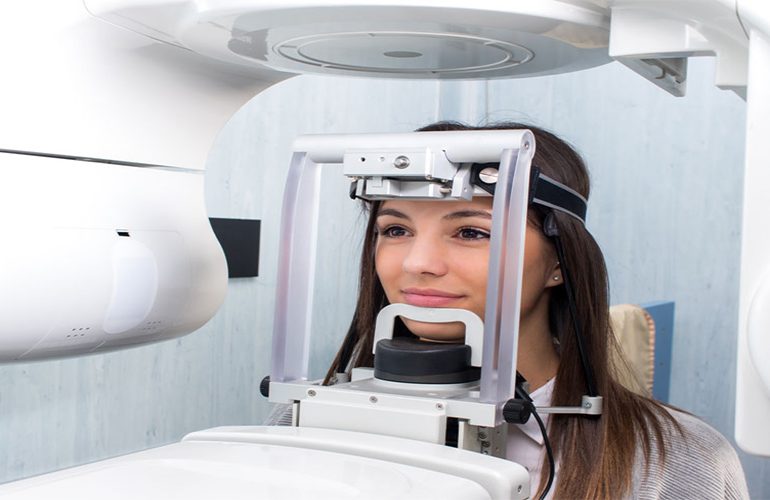
The posterior region of the upper jaw is one of the areas requiring the most attention in implant planning. After teeth are lost, the bone in this region loses height and the sinus cavity may expand downward over time. As a result, the amount of bone that will carry the implant becomes insufficient. Sinus lift planning aims to increase bone volume so that a safe implant can be placed in this region, and it is not possible to make the decision without three-dimensional imaging. As DijiDent Oral and Dental Health Polyclinic, in Türkiye we base planning on measurement in such cases.
Why Is the Posterior Upper Jaw Different?
The maxillary sinus is an air-filled cavity located inside the upper jawbone. After tooth loss, two processes work at the same time: bone height decreases and the sinus floor shifts downward. When these two effects combine, the strip of bone in which the implant can be placed becomes thinner. At the same time, the bone in this region has a softer structure compared to the lower jaw; this is also taken into account in planning.
What Does Tomography Determine in Planning?
- Existing bone height: The true distance between the sinus floor and the crest of the jawbone is measured.
- Whether a lift is needed: In some cases the existing bone is sufficient and no additional procedure is needed.
- Choice of method: Depending on the amount of bone, it is evaluated which of the closed (crestal) or open (lateral window) approaches is suitable.
- Sinus health: Whether there is thickening of the sinus membrane, a cyst or inflammatory findings is examined; if necessary, the opinion of the relevant specialist physician is obtained.
- Anatomical variations: There may be partitions (septa) inside the sinus; these directly affect the surgical approach.
None of this information can be reliably measured on a two-dimensional panoramic film. For this reason, when the sinus region is concerned, three-dimensional imaging becomes not a preference but the foundation of planning.
The Difference Between the Closed and Open Approach
When the existing bone height is relatively sufficient, a more limited technique can be applied in which the sinus floor is pushed upward in a controlled manner through the implant site. When the amount of bone is significantly reduced, a more comprehensive method comes into consideration in which a window is opened from the side and graft material is placed. Which one is suitable is determined according to the measurement results and clinical evaluation.
The Measurement Result Does Not Always Mean an Additional Procedure
A common misperception our patients encounter is that everyone with missing teeth in the posterior upper jaw needs a sinus lift. However, the rate and degree of bone loss vary significantly from person to person. In cases where the measurement shows that the existing height is sufficient, an implant is planned directly. For this reason, the decision is made not with general assumptions but with your images.
Process and Healing Expectations
In some cases, the sinus lift and the implant can be performed in the same session; in others, the bone is first allowed to mature and the implant is placed at a later stage. This decision depends on the amount of existing bone. After the procedure, swelling and sensitivity for a few days are considered normal. During this period, you are asked to avoid blowing your nose forcefully, sneezing strongly and drinking through a straw; the aim is to prevent pressure changes in the area.
For our patients coming from abroad, the need for an additional procedure directly affects the schedule. For this reason, at DijiDent we share the possible scenarios and the total duration from the start after imaging; we do not think it is right for you to be faced with an unexpected decision in the middle of the process.
Frequently Asked Questions
No. It only comes into consideration when bone height in the posterior upper jaw is insufficient. If the measurement is sufficient, an implant can be planned directly.
It is not an expected outcome in applications performed with appropriate planning and technique. However, existing sinus problems should be evaluated in advance; if necessary, collaboration with an ear, nose and throat specialist is undertaken.
Maturation of the graft takes a period of time that varies by case. The exact duration is stated by your dentist according to the method used and your personal healing rate.
The procedure is performed under local anesthesia; no pain is expected during the procedure. The subsequent swelling and sensitivity are managed as recommended by your dentist.
Smoking is an important factor that can negatively affect graft and implant healing. It is recommended that you quit or minimize it throughout the process.
Different graft options are evaluated depending on the case. Which material will be used is explained by your dentist according to the clinical situation.
The sentence “your bone is not enough” is not always the last word.
Contact us to book an appointment to have the bone condition in your upper jaw measured and a suitable roadmap drawn up for an implant. Let us carry out your three-dimensional imaging-supported evaluation at DijiDent Oral and Dental Health Polyclinic.
This content is for general information purposes. Surgical suitability, method and duration vary from person to person; the decision is made after the dentist’s examination and radiological evaluation.