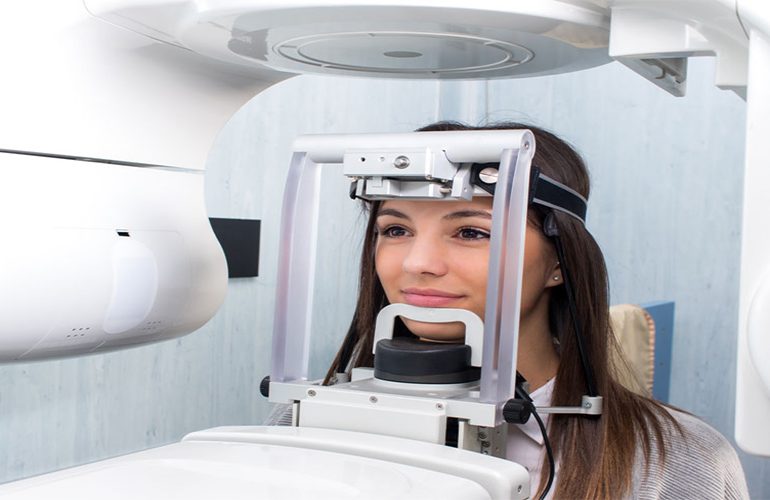
When pain starts again months or years later in a tooth that has had root canal treatment, most patients reach the same conclusion: “This tooth cannot be saved.” However, behind the recurring complaint there is often an overlooked anatomical detail that is not visible on a two-dimensional film. When root canal treatment is re-evaluated with the support of tomography, it may be possible in many cases to reach a solution without extracting the tooth. As DijiDent Oral and Dental Health Polyclinic, in the endodontic approach we apply in Türkiye, we consider extraction the last option.
Why Does a Root Canal-Treated Tooth Hurt Again?
The aim of treatment is to clean the canal system and fill it so as to leave no space for bacteria to shelter. The return of the complaint usually stems from a deficiency in one link of this chain:
- Missed additional canal: Particularly in upper molars, some patients may have an extra canal. This uncleaned canal remains a source of infection.
- Incomplete or overextended filling: The tip of the canal may not have been reached, or the material may have extended beyond the root.
- Coronal leakage: Bacteria may leak over time from the edge of the overlying filling or crown.
- Root fracture: Vertical root fractures are often not noticed on a panoramic film.
- Complex canal anatomy: Curved, merging or branching canals may not have been fully shaped.
Why Is a Two-Dimensional Film Insufficient?
In periapical and panoramic images, tooth roots overlap. A tooth that appears to have three canals may actually have four; a small lesion that has developed behind the root may remain completely hidden. In addition, bone loss only becomes visible on a two-dimensional film when it reaches a certain size and develops in a certain direction. For this reason, the sentence “nothing is visible on the film” does not mean there is no problem.
What Does Tomography Show in These Cases?
Three-dimensional imaging makes it possible to examine the canal system in three planes. In practice this means the following: the presence of an additional canal can be evaluated, how far the filling extends along the canal can be measured, and the true size of the lesion at the root tip and its relationship with neighboring structures can be seen. In the upper jaw, the relationship of the lesion with the sinus floor, and in the lower jaw, with the nerve canal, is also evaluated.
This information is decisive not only for diagnosis but also for the decision. If the problem originates from a canal that can be cleaned, retreatment makes sense. If a vertical root fracture has been detected, the chance of success of attempts to preserve the tooth decreases and alternatives need to be discussed. What the patient values most is that this distinction is made clearly.
Why Is Preserving the Tooth a Priority?
A natural tooth contributes to the preservation of the jawbone by stimulating it, and the balance it establishes with neighboring teeth cannot easily be imitated. When a tooth is extracted, the implant or bridge planned in its place means additional cost and additional time. For this reason, saving a tooth that can be preserved is generally a more advantageous option in the long term.
Retreatment, Surgery or Extraction?
At DijiDent, we evaluate these three options together in light of the imaging findings and the clinical examination. Intracanal retreatment involves removing the existing filling and cleaning the system again. In some cases, if there is a problem that cannot be reached through the canal, a surgical approach directed at the root tip (apical resection) may come into consideration. Extraction is recommended only in cases where it does not seem possible for the tooth to maintain its function in the long term.
Your Role in the Decision Process
The expected success, duration and subsequent restoration required differ for these three options. When your dentist shows the findings on screen, you understand by seeing why they are recommending a particular path. Making the decision together ensures both that your expectations remain realistic and that the process is predictable for you.
Frequently Asked Questions
No. In cases with a root fracture, excessive loss of tooth structure or advanced bone loss, the expected success decreases. A detailed evaluation is needed to make this distinction.
In some cases, the restoration may need to be removed to reach the canal system. This possibility is explained clearly to you before treatment.
Painless lesions may also require follow-up or treatment. The decision is made according to the size and course of the lesion; in some cases regular monitoring is preferred.
Antibiotics do not eliminate the source of the infection; they can only temporarily suppress the symptoms. The permanent solution lies in cleaning the canal system. Medication use should be on a doctor’s recommendation.
It varies according to the complexity of the case. The level of infection and canal anatomy are decisive; the duration is communicated to you at the first evaluation.
Get a second evaluation before having your tooth extracted.
If you are experiencing recurring pain or swelling, we can clarify the source of the problem with three-dimensional imaging. Contact us to book an appointment; let us examine together at DijiDent Oral and Dental Health Polyclinic whether your tooth can be preserved.
This content is for general information purposes. The treatment decision and expected success vary from person to person; the evaluation is made by your dentist.