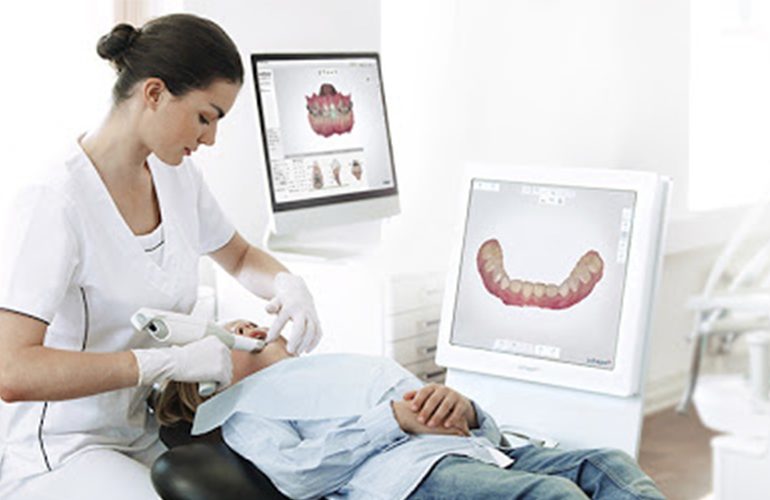
The process does not end when the surgical stage of implant treatment is completed; the truly visible result emerges with the prosthesis to be placed on top. Fit accuracy is particularly important at this stage, because implants are not supported by a flexible connective tissue like natural teeth, and an ill-fitting superstructure places load directly on the implant and the surrounding bone. In the production of implant-supported prostheses, the digital workflow is used to support this accuracy. As DijiDent Oral and Dental Health Polyclinic, in Türkiye we plan this process from the start.
How Is a Digital Impression Taken for an Implant?
Unlike natural teeth, the part of the implant visible in the mouth is not a surface but a connection point. For this reason, a small part called a scan body is attached to the implant before scanning. This part converts the position and angle of the implant into a form the scanner can read. When the scan is completed, the software calculates the three-dimensional position of the implant based on this reference.
How Does the Process Proceed?
- The healing cap is removed and the scan body is placed.
- The lower jaw, upper jaw and bite are scanned.
- If necessary, an additional scan is taken to record the shape of the gum.
- The scan body is removed and the healing cap is put back.
- The data is sent to the laboratory, the design is prepared and submitted for the dentist’s approval.
In the conventional method, this stage was done with impression transfers and paste; the patient had to wait with their mouth open for a long time. In the digital method, the waiting time is eliminated.
Prosthesis Options
Screw-Retained Prostheses
The superstructure is fixed to the implant with a screw. Its greatest advantage is that it can be easily removed and reattached when necessary; this provides practicality in terms of maintenance, check-ups and possible repair. The screw access hole requires planning in the aesthetic zone.
Cemented Prostheses
The superstructure is fixed by cementing it onto the abutment. It can offer an aesthetic advantage; however, careful application is required so that excess cement does not remain below the gum.
Removable Implant-Supported Prostheses
In completely toothless jaws, attachment systems that allow the prosthesis to hold onto the implants are used. The prosthesis can be removed by the patient; this makes cleaning easier.
Which option is suitable is determined according to the number and position of implants, the bone condition, aesthetic expectations and your cleaning habits.
The Importance of Gum Shaping
The natural appearance of an implant-supported prosthesis is not only about the form of the tooth; it is also about how the surrounding gum is shaped. The caps and temporary restorations used during the healing period give the gum the desired contour. The scan taken after this shape has formed ensures that the permanent prosthesis is produced with the correct profile. Skipping this stage, especially in the front region, can result in an outcome that is technically flawless but looks visually artificial.
The Contribution of the Digital Workflow
Scan data can be combined with the tomography and planning records taken before surgery. In this way, the prosthesis is no longer a part adapted afterwards to the position of the implant; it becomes the realization of the goal planned from the start. In addition, since the data is archived, a new impression may not be needed if a part needs to be renewed in the future.
Continuity of Check-Ups
Implant-supported prostheses are not structures that can be left alone once placed. Screw loosening, bite changes and tissue health around the implant should be checked regularly. During these check-ups, the prosthesis may need to be removed and cleaned; this is another advantage of screw-retained systems.
Limits in Full-Arch Cases
In long-span scans involving many implants, data merging precision becomes more critical. In these cases, additional reference methods or verification steps may be used; in some situations, a combined approach with the conventional method is preferred. At our clinic, we make this decision according to the case.
Frequently Asked Questions
The prosthetic stage is started after it has been confirmed that integration with the bone is complete. This evaluation is made by your dentist.
No. The impression and try-in stages are painless; anesthesia is usually not needed.
It varies according to the scope of the case. The process is shorter for a single implant and longer in full-arch cases.
Screw loosening may be seen over time; it is easily tightened at check-ups. If it recurs frequently, the bite is evaluated.
Interdental brushes and special dental floss are recommended. Regular professional check-ups are essential.
Yes. Since the digital record is stored, the production process usually proceeds faster.
Let us plan from the start the tooth that will go on your implant.
Let us determine together the suitable option and timeline for your prosthetic stage. Contact us to book an appointment; let us proceed with a digital workflow at DijiDent Oral and Dental Health Polyclinic.
This content is for general information purposes. The type of prosthesis and the process are determined by your dentist after the clinical examination.