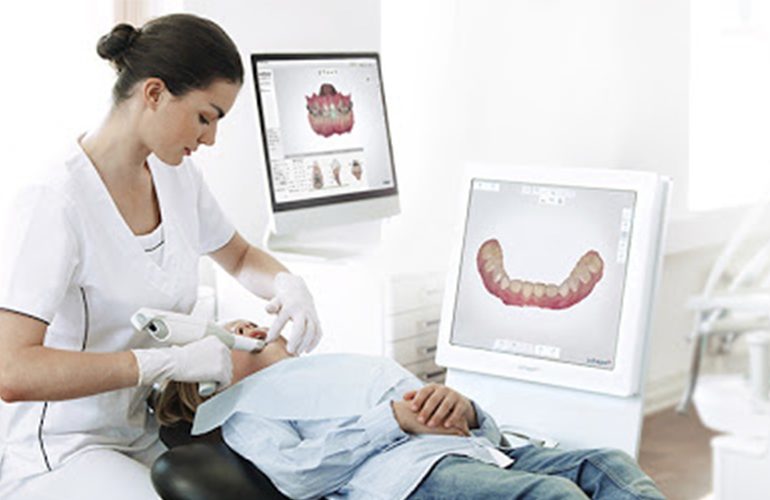
In children, the success of dental treatment depends as much on how the experience is lived as on the technique itself. A child who remembers their first appointment badly can turn into an adult who resists going to the clinic in later years. The impression-taking stage is one of the most challenging points of this experience. Digital impressions in children make the process significantly easier because they require no paste and no waiting. As DijiDent Oral and Dental Health Polyclinic, our priority with our child patients in Türkiye is not to let treatment become a negative memory.
Why Is It More Suitable for Children?
- No waiting: What children struggle with most is waiting while staying still. Scanning eliminates this.
- No choking sensation: No material that fills the mouth is placed.
- It can be divided: It can proceed at short intervals, with breaks.
- Visual interest: Watching their own teeth take shape on screen is often fun for children.
- Ease of repetition: An area spoiled by movement can be retaken without repeating the entire procedure.
In Which Treatments Is It Used?
In child patients, digital impressions are used in the preparation of early orthodontic appliances, in the production of space maintainers applied when a baby tooth is lost early, in clear aligner treatments, in the preparation of sports mouthguards and in monitoring tooth development. They are also valuable for recording the position of a tooth that has undergone trauma and tracking its change over time.
The Value of Use for Follow-Up
In children, the structure of the mouth changes rapidly. When two scans taken six months apart are superimposed, the direction of tooth eruption, jaw development and changes in spacing between teeth can be seen objectively. This is follow-up data obtained without any exposure; it is also important because it can reduce the need for radiological imaging.
The Value of an Early Get-Acquainted Appointment
In children, the first appointment not being a treatment appointment makes a significant difference in the long run. A short visit planned just to get acquainted, sit in the chair and see the devices turns the clinic into a familiar environment. Children who come this way show much higher cooperation in subsequent procedures. In a child who first meets the clinic with acute pain, however, the experience is framed negatively from the start.
How Should You Prepare Your Child?
Some sentences that parents say with good intentions unknowingly increase anxiety. Expressions such as “don’t be scared,” “it won’t hurt” or “they won’t give you a shot” bring to the child’s mind possibilities they had not thought of until then. Instead, a concrete and calm explanation is recommended: “The doctor will take pictures of your teeth with a small camera, and we’ll watch them together on the screen.”
Scheduling the appointment for a time when the child is rested, and not having it coincide with nap time or mealtimes, also makes the process easier. In addition, if you have dental anxiety yourself, take care not to reflect it onto your child; children quickly read their parents’ body language.
The Difference Between Reward and Pressure
Showing the child a small token of appreciation after the procedure provides positive reinforcement; however, bargaining before the appointment such as “if you behave, I’ll buy you this” gives the child the message that they will face something difficult. Instead of raising expectations, treating the process as an ordinary check-up is more effective. On days when the child does not cooperate, postponing the appointment instead of forcing gives better results in the long run.
The Approach We Apply at the Clinic
We show the device first, let the child touch it with their hands and explain what we will do in simple sentences. For some children, doing a short trial in the parent’s mouth first works well. We agree on a stop signal during the scan; the child knowing they can stop the process gives them a sense of control and reduces their reaction.
Frequently Asked Questions
No. When the child does not cooperate, no forceful approach is applied; the appointment is postponed or gradual familiarization is planned.
There is no fixed age limit; what is decisive is the child’s ability to cooperate. At young ages, it proceeds in short segments.
Only the affected area is rescanned; the procedure is not redone from the start.
No. It is an optical method, not an X-ray.
Yes. In the younger age group, the parent’s presence often makes the process easier.
We do not force them. A get-acquainted appointment can be arranged so that the child gets used to the environment.
It depends on the planned treatment. Your dentist determines which records are needed.
Your child’s first experience shapes their future dental health.
Let us plan an appointment suitable for your child for a check-up, orthodontic evaluation or space maintainer need. Contact us to book an appointment; let us carry out the process patiently at DijiDent Oral and Dental Health Polyclinic.
This content is for general information purposes. The method to be applied in children is determined by your dentist after the clinical examination.