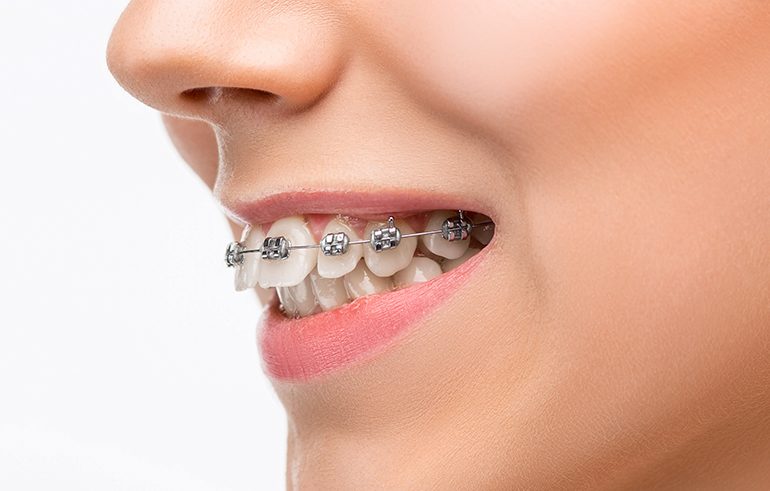
Teeth appearing to be straight is not enough on its own; how the lower and upper jaws close together is at least as important as the alignment. In addition to affecting appearance, malocclusion is directly related to chewing, speech, tooth wear and jaw joint health. As DijiDent Oral and Dental Health Polyclinic, in Türkiye we consider bite analysis a central step in the orthodontic evaluation.
What Is a Normal Bite Like?
In a healthy bite, the upper front teeth cover the lower front teeth by a limited amount and the back teeth fit together in an orderly way. This relationship ensures that chewing forces are distributed evenly. When this arrangement is disturbed, force concentrates on certain teeth and problems form over time.
Open Bite
This is the situation in which the front teeth do not touch each other when the back teeth are closed. The person cannot bite with their front teeth; they struggle to bite off foods such as sandwiches, lettuce or pasta and usually hand this job over to the side teeth.
Causes
- The thumb-sucking habit continuing after the permanent teeth have erupted
- Tongue thrusting; the tongue pressing on the front teeth during swallowing
- Mouth breathing and the related change in tongue position
- Skeletal structure; differences in the vertical development of the jaws
- Long-term pacifier or bottle use
Effects
Reduced biting function is the most obvious consequence. In addition, the load on the back teeth increases and wear on these teeth may accelerate. In speech, differences may be seen, especially in S sounds.
Deep Bite
This is the upper front teeth covering the lower front teeth more than necessary. In advanced cases, the lower incisors are not visible at all when smiling and, in the bite, may touch the palatal tissue behind the upper teeth.
Causes
- Differences in the skeletal jaw relationship
- Early loss of back teeth and reduced vertical support
- Decrease in back tooth height due to wear
- The long-term effects of a teeth clenching habit
Effects
Contact of the lower incisors with the palatal tissue may lead to chronic irritation and gum recession in that area. Wear on the front teeth accelerates. In addition, a decrease in bite height may affect lower facial proportions and contribute to strain on the jaw joint in some patients.
Other Bite Problems
Apart from open and deep bites, there are other conditions that are evaluated. Pronounced protrusion of the upper front teeth, the lower jaw being positioned forward relative to the upper jaw, or midline discrepancies are within this scope. Some of these stem from the position of the teeth and some from the jaw relationship. Since this distinction directly determines the treatment plan, a detailed analysis is carried out.
Treatment Approaches
Treatment is determined according to whether the problem is dental or skeletal. In dental cases, correction is possible with orthodontic movements. In situations where the skeletal component is pronounced, appliances that guide jaw development can be used in growing children; in adults, a surgically assisted plan may come into consideration.
In an open bite, managing habits is also critically important. If tongue thrusting or thumb sucking continues, moving the teeth alone does not give a permanent result; as long as the habit continues, the likelihood of relapse is high. For this reason, habit treatment is part of the plan in these cases.
Restorative Support
In deep bites that develop due to wear, restoring the lost tooth length with restorative methods can be planned together with orthodontic treatment. In such combined cases, the sequence is important; first the position is corrected, then the form is completed.
The Effect of the Bite on Speech
The relationship of the front teeth plays a direct role in the formation of some sounds. In an open bite, air leakage may occur with S and Z sounds; in a deep bite, lip and tongue movements may be restricted. For this reason, bite correction also brings a positive change in pronunciation in some patients. This aspect is also evaluated when planning treatment.
The Role of Early Evaluation
In children, malocclusions can be guided more easily while jaw development continues. For this reason, an orthodontic evaluation in the period when the permanent teeth begin to erupt may make more comprehensive treatments unnecessary in the future.
Frequently Asked Questions
Not every bite difference requires treatment. If there is wear, a gum problem or a joint complaint, an evaluation is recommended.
No. It is related to chewing, wear, gum health and the jaw joint.
If it is caused by a habit, it may partially correct when the habit is given up; an evaluation is needed.
It may deepen if wear and tooth loss continue; follow-up is recommended.
It is possible in some cases; fixed treatment may be preferred in complex cases.
No. It only comes into consideration in pronounced skeletal discrepancies.
Your bite should be evaluated even if your teeth look straight.
If you have difficulty biting, wear or jaw complaints, have a check-up. Contact us to book an appointment; let us carry out your bite analysis at DijiDent Oral and Dental Health Polyclinic.
This content is for general information purposes. Diagnosis and the treatment plan are determined after clinical and radiological evaluation.