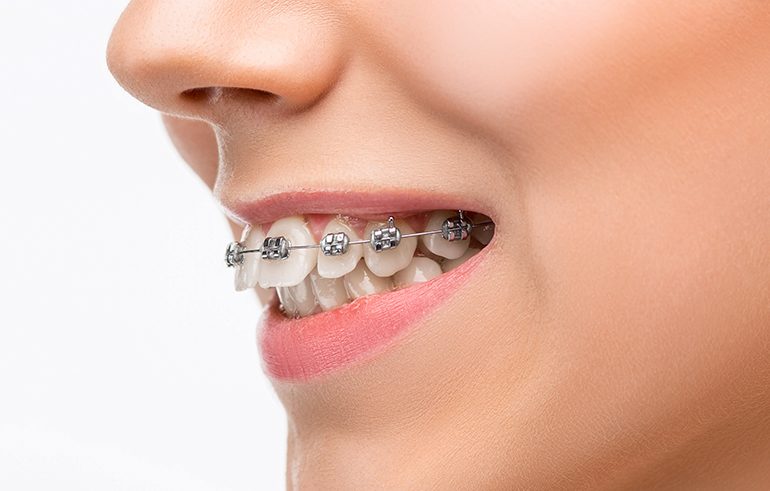
Orthodontic treatment is the process of moving teeth within the bone. For this movement to be safe, the tissues surrounding the tooth need to be healthy. Force applied on an inflamed foundation may cause permanent damage while providing correction. For this reason, a gum evaluation before orthodontics is the first step of treatment and one that must not be skipped. As DijiDent Oral and Dental Health Polyclinic, in Türkiye we have made this step our standard practice.
Why Is It So Critical?
When orthodontic force is applied to healthy tissue, the bone remodels in a controlled manner. However, if the supporting tissue is already experiencing loss due to gum disease, the force applied may accelerate this loss. As a result, the teeth are aligned; but their support has been weakened.
This is not a theoretical risk. Gum disease is common, especially in adult patients, and often goes unnoticed because it progresses painlessly. For this reason, the periodontal examination before orthodontics becomes even more important with age.
What Is Examined in the Evaluation?
- Pocket depths: The distance between the tooth and the gum is measured.
- Bleeding index: It is an indicator of active inflammation.
- Bone level: It is evaluated radiologically.
- Gum recession: Its location and amount are recorded.
- Gum thickness (biotype): Thin tissues are more affected by movement.
- Tooth mobility: It may be a sign of loss of support.
The Treatment Process
When gum disease is detected, professional cleaning, root planing if necessary and home care training are applied. Then time is allowed for the tissue to heal and a re-evaluation is done. If the bleeding has stopped and the tissue has become stable, orthodontic treatment begins.
This stage delays treatment; however, if it is skipped, much more is lost. We tell our patients this: a wait of a few weeks is more acceptable than a loss of support that will last for years.
In Patients with Gum Recession
In areas with recession, the direction of the planned movement is of great importance. Pushing the tooth outwards, that is, towards the thin bone wall, may increase recession. In these cases, the movement plan is designed with the bone limits in mind; if necessary, bone thickness is evaluated with three-dimensional imaging.
In some cases, applications aimed at strengthening the gum tissue may come into consideration before orthodontics. This is a step that does not prevent treatment but makes it safe.
Black Triangles
After orthodontic treatment, triangular gaps may be seen between the teeth, especially in adult patients. The reason for this is not the treatment but the already existing underlying gum recession: the gap that remains hidden while the teeth overlap becomes visible after they are aligned.
It is important to discuss this possibility before treatment. Proceeding with knowledge of the possibility, rather than facing an unexpected result, preserves satisfaction. If necessary, restoratively adjusting the contact point between the teeth or reducing the gap with limited interproximal reduction may be considered.
Smoking and Systemic Conditions
Smoking negatively affects the healing response of the gum tissue and can mask warning signs such as bleeding. Uncontrolled diabetes also poses a risk in terms of periodontal health. These conditions are not an obstacle to orthodontics; however, they require the planning and follow-up frequency to be adjusted accordingly. For this reason, it is important that you share the medications you use and your systemic conditions.
The Contribution of Orthodontics to the Gums
This relationship is not one-way. Overlapping teeth create areas that are difficult to clean and prepare the ground for chronic gum inflammation. When alignment is achieved, these areas become reachable with a brush and floss. In other words, orthodontic treatment done under the right conditions is an investment that supports gum health in the long term.
Follow-Up Throughout Treatment
The periodontal evaluation is not limited to before treatment. Since plaque accumulation around the brackets increases during orthodontics, the gums are checked regularly and professional cleaning intervals are kept short.
Frequently Asked Questions
They need to be treated first; movement on an inflamed foundation may be risky.
It is not expected with properly planned movements; the risk increases with movements that push the limits.
Restorative adjustment or limited interproximal reduction can be considered.
Once it is made stable, it is possible in many cases; an evaluation is needed.
It depends on the level of the disease; additional time is needed for healing.
There is no lasting result without a solid foundation.
Let us evaluate your gum health in detail before starting orthodontics. Contact us to book an appointment; let us plan the process in the right order at DijiDent Oral and Dental Health Polyclinic.
This content is for general information purposes. Diagnosis and the treatment plan are determined after clinical and radiological evaluation.