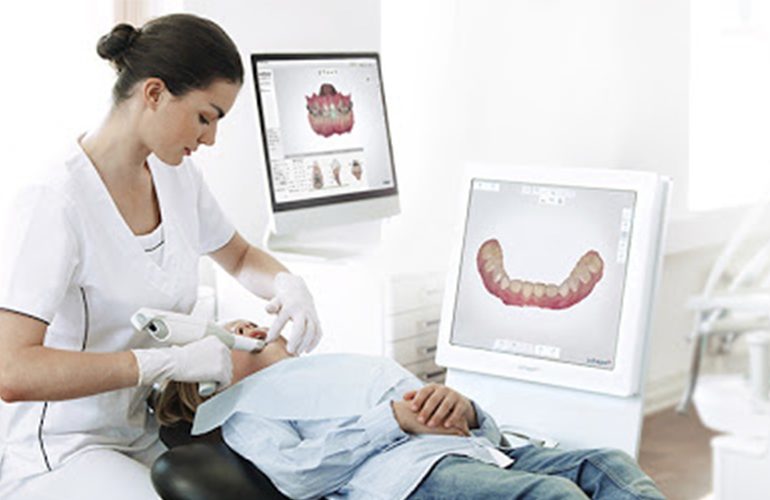
A digital impression gives reliable results when applied under the right conditions. However, technology alone does not guarantee accuracy; there is a chain of conditions that determines the result. For a patient whose crown does not fit, the sentence “a digital impression was taken” is not explanatory on its own. Digital impression accuracy depends more on the conditions of application than on the device. As DijiDent Oral and Dental Health Polyclinic, at our clinic in Türkiye we manage these conditions with a standard protocol.
Clinical Conditions
Gum Health
The scanner records only the surface it sees. If the crown margin is below the gum and that area is inflamed or bleeding, the margin cannot be read. For this reason, gum health must be established before the impression. When we tell our patients “gum treatment first,” this is not prolonging the process; it is securing the result.
Moisture and Saliva
Moisture on the surface can disrupt optical reading. Regional drying and isolation are therefore an integral part of scanning.
Soft Tissue Control
The cheek, lip and tongue entering the scanning area add unnecessary data to the model. Retractors and correct positioning prevent this problem.
Scanning Technique
The path the scanner follows is not random. Each device manufacturer recommends a specific scanning strategy that minimizes data loss. The operator following this strategy can be more decisive than the model of the device. In addition, holding the device at the appropriate distance and angle to the surface, maintaining a balanced speed and noticing areas with data loss instantly are skills that develop with experience.
What Happens as the Distance Increases?
The scanner builds the model by adding successive images to one another. At each merging step, there is a very small margin of deviation. Over short distances this margin remains negligible; this is why a digital impression gives strong results for a single crown. However, in scans extending across the full arch, deviations can accumulate. This does not mean that a digital impression cannot be used; it means that additional verification steps become important in long-span cases.
Patient-Related Factors
- Being able to open the mouth sufficiently and maintain the position
- The level of the gag reflex
- The tongue entering the scanning area
- The presence of mobile or loose teeth
- Many shiny metal restorations
Shiny surfaces can create reflections in some optical systems. In such cases, the protocol is adapted or complementary methods are considered.
The Separate Importance of the Bite Record
The scan records not only the shape of the teeth but also how the two jaws close together. During this recording, the patient needs to bite not in a habitual position but in the correct bite relationship. An incorrectly taken bite record causes the restoration to be too high even if the model of the teeth is flawless. For this reason, the bite record is taken with separate care and verified when necessary.
Software and Calibration
Regular calibration of the devices should be performed at intervals specified by the manufacturer. Software updates also directly affect data merging algorithms. These are background processes that the patient cannot see but that determine the result.
The Distinction Between Accuracy and Repeatability
A good impression requires two separate properties. Accuracy refers to how close the obtained model is to the real oral structure; repeatability refers to how similar impressions taken under the same conditions are to one another. A method can give consistent results and still deviate from reality. For this reason, both properties are considered together in clinical evaluation.
Why Did My Crown Not Fit?
There is no single answer to this question. A deficiency at the impression stage may be a factor, but a change in gum healing, the temporary restoration compressing the gum, the laboratory stage or a problem in the bite record may also play a role. The right approach is to determine in which link of the chain the problem lies, rather than moving to reproduction without investigating the cause.
Frequently Asked Questions
In laboratory studies, comparisons are made with reference models. In the clinical setting, what is decisive is the fit of the restoration in the mouth.
Device quality is important; however, clinical conditions and application technique are at least as decisive.
It is used in many cases; additional verification steps may be planned in long-span work.
No. Rescanning an inadequate area shows that quality control is working.
Usually yes. Establishing gum health first is necessary for the reliability of the result.
Mobile teeth can shift during recording. This situation is evaluated by your dentist and, if necessary, treated first.
A well-fitting restoration starts with an impression taken under the right conditions.
If you have experienced a fit problem before, let us investigate the cause together. Contact us to book an appointment; let us set up the process correctly from the start at DijiDent Oral and Dental Health Polyclinic.
This content is for general information purposes. The method and protocol to be applied are determined by your dentist after the clinical examination.