The most overlooked stage of orthodontic treatment begins after the braces are removed. Even if the teeth settle into their new positions, the fibers and bone tissue around them need time to adapt. If protection is not provided during this period, the teeth tend to return to their old positions. An orthodontic retainer aims to preserve the result achieved with treatment. As DijiDent Oral and Dental Health Polyclinic, in Türkiye we treat this stage not as an optional add-on to treatment but as a mandatory part of it.
Why Do Teeth Tend to Return to Their Old Position?
A tooth is not a fixed structure within the bone; it is attached to the bone via the periodontal fibers around it. During orthodontic movement, these fibers are stretched and need months to adapt to the new position. In addition, the forces exerted by the lip, cheek and tongue muscles continue throughout life. The natural tendency toward crowding of the lower front teeth seen with age also adds to this picture. In short, retention is not a sign of treatment failure but a requirement of biology.
Types of Retainers
Fixed Retainers
These usually consist of a thin wire bonded to the back surface of the front teeth. They are invisible and do not depend on patient compliance; they are always on duty. However, cleaning them requires attention: the use of interdental brushes and special dental floss is recommended. Tartar accumulation around the wire is managed with regular check-ups.
Removable Retainers
Clear aligner-type retainers or conventional wire-clasp retainers are in this group. They are put in and taken out by the patient; they are easy to clean. However, success depends directly on wearing discipline. While an unused retainer waits in a drawer, the teeth move, and after a while the retainer no longer fits.
In many cases, the two methods are planned together: such as a fixed wire in the lower jaw and a retainer worn at night in the upper jaw.
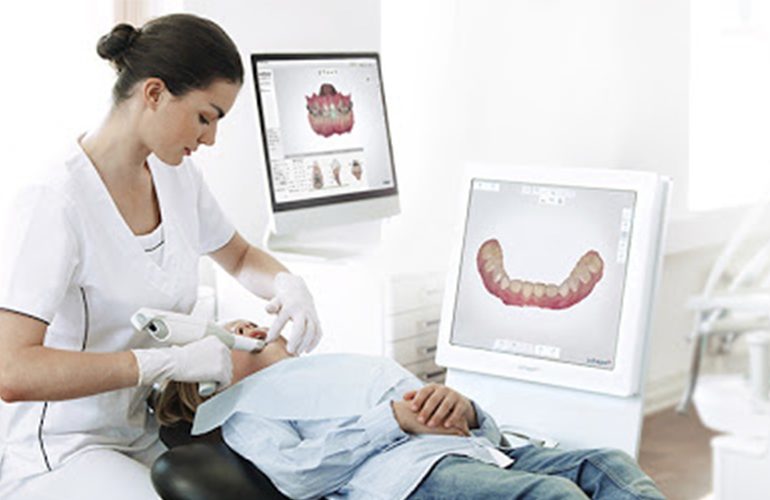
How Does Digital Scanning Make This Stage Easier?
- Fast production: With the scan taken at the end of treatment, the retainer can be produced in a short time; waiting time decreases.
- Reproduction from the archive: When a retainer is lost or broken, a new one can be produced from the saved model. This may not require the impression to be repeated.
- Reference model: The scan taken after treatment forms a comparison point for understanding whether any shifting has occurred in the future.
- Remote planning: The renewal process can be organized in advance for patients living abroad.
The second item in particular makes a big difference in practice. What a patient who has lost their retainer worries about most is their teeth moving in the meantime. Fast production from the archived model helps reduce this risk.
Cleaning Around the Retainer
Fixed retainers create an area on the back surface of the lower front teeth that is prone to tartar accumulation. This area cannot be completely cleaned with normal brushing; interdental brushes and special floss that can be threaded under the wire are needed. When neglected, gum inflammation and tartar formation can be seen. For this reason, we plan professional cleaning intervals closer together for our patients who use retainers.
How Long Should It Be Worn?
There is no single answer to this question, and it is necessary to be realistic: retention is not a period limited to a few months. Today, the common approach is to maintain protection in the long term, even if the frequency of wear is reduced over time. The wearing schedule and duration are determined individually by your dentist.
What Should You Do If the Wire Breaks?
When one end of a fixed retainer comes loose, go to the clinic without delay. A broken wire not only loses its function; because it is attached at only one point, it can also cause unwanted movement of the tooth. This is a situation that should not be postponed.
Frequently Asked Questions
It may be noticeable in the first days; most patients get used to it in a short time. If you feel a sharp end, come in for a check-up.
The likelihood of the teeth moving toward their old positions increases. This can lead to a situation in which treatment may need to be repeated.
It varies by case. Most often, the two are planned together.
Do not force it. The teeth may have moved; go to the clinic for evaluation.
A slight difference may be felt in the first days; adaptation usually happens quickly.
If the archived model is current, it may not be needed. However, if there has been movement of the teeth, a new scan is taken.
Preserving the result of your treatment is as important as the treatment itself.
If your retainer has broken or been lost, or you have noticed shifting in your teeth, do not wait. Contact us to book an appointment; let us review your retention plan at DijiDent Oral and Dental Health Polyclinic.
This content is for general information purposes. The type of retainer and duration of use are determined individually by your dentist.