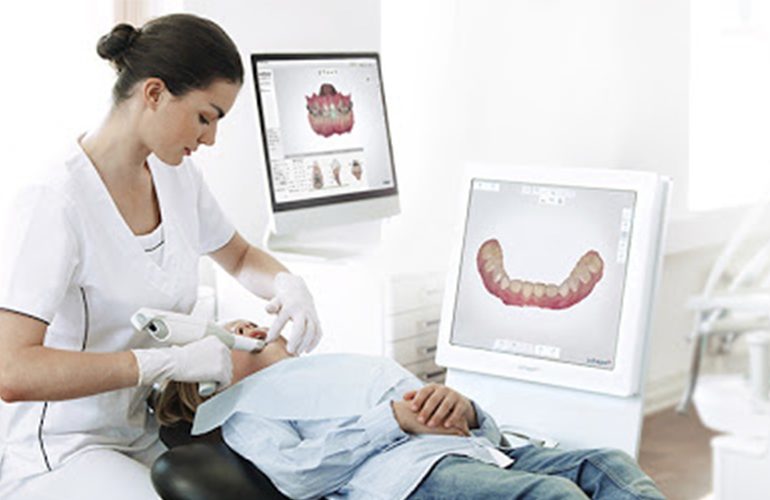
Because digital scanning is an optical method, it records whatever is on the surface. This simple fact gives rise to the most important rule in practice: the surface to be scanned must be clean and dry. A layer of saliva, blood or moisture can prevent the scanner from reading the tooth surface as it is. Moisture control during scanning is therefore not a technical detail but a stage that directly determines the result. As DijiDent Oral and Dental Health Polyclinic, at our clinic in Türkiye we apply this step with care.
Why Does Moisture Cause a Problem?
A thin layer of saliva on the tooth surface reflects light differently and can disrupt the scanner’s depth calculation. As a result, blurry areas, gaps or protrusions that do not exist in reality can form in the model. When these areas are sent to the laboratory unnoticed, the fit of the produced restoration is negatively affected. For this reason, the screen is constantly monitored during scanning and suspicious areas are rescanned immediately.
Blood and the Gum Margin
If the crown margin ends just below the gum, this area needs to be made visible. If the gum is inflamed and bleeds when touched, the scan cannot read this margin. At our clinic, the priority approach in this case is not to force the impression but to establish gum health. In healthy tissue, exposing the margin is both easier and more comfortable for the patient.
Methods Used
- Use of air and suction: Regional drying is the basic step of scanning.
- Retractors: They keep the cheek and lip away, providing visibility and reducing moisture accumulation.
- Cotton rolls and absorbent pads: They control accumulation in the areas where the salivary glands open.
- Retraction cord: A thin thread used to temporarily expose the gum margin.
- Regional progression: The scan is done area by area so that dryness is maintained at each stage.
You may feel slight pressure during retraction cord application; however, the procedure is usually painless and brief.
The Patient’s Part
There are things you can do to make the process easier. During the scan, it is enough to breathe comfortably, use the breaks your dentist gives you to swallow when needed and try to keep your tongue away from the scanning area. Holding your breath increases tension and can affect saliva secretion. Giving a signal when you are struggling allows the process to be stopped and restarted.
The Situation in Patients with Dry Mouth
Some medications, systemic diseases and age-related changes cause dry mouth. In these patients, moisture control is not a problem; however, excessive drying of the surface can also cause discomfort. In this case, the scan is done in shorter segments and the tissues are allowed to become moist in between. If you have dry mouth, inform your dentist; it is a finding that needs to be evaluated both for the impression and for general oral health.
Is Powder Application Still Necessary?
With some first-generation scanners, a thin layer of powder had to be applied so that the surface could be read. This step both took time and could be uncomfortable for the patient. Most devices used today work without powder. Nevertheless, when certain materials and very shiny surfaces are involved, surface preparation may be necessary with some systems.
Why Can the Scan Be Repeated?
Rescanning an area is normal and does not mean an error. Moisture accumulation, the tongue getting in the way or a small movement can corrupt the data in that area. One of the greatest advantages of the digital method is that, in this case, not the entire impression but only the relevant area is repeated. In a conventional impression, the same problem would mean redoing the procedure completely from the start.
Frequently Asked Questions
Yes. Since plaque and deposits on the surface will be recorded by the scanner, cleaning is done before the impression.
Yes. Breaks are given between stages; you just need to signal your dentist when you need to swallow.
Usually a slight pressure is felt. If necessary, local anesthesia can be considered.
It can be taken; however, reliability decreases in the margin area. For this reason, it is recommended that gum health be established first.
No. Regional, short-term air application does no harm; only temporary sensitivity may be felt.
Usually not. Only the relevant area is rescanned, which takes a short time.
A correct result starts with clean data.
If you are planning a crown, prosthesis or guard treatment, let us carry out the process comfortably and correctly. Contact us to book an appointment; let us carefully plan your impression stage at DijiDent Oral and Dental Health Polyclinic.
This content is for general information purposes. The method to be applied is determined by your dentist after the clinical examination.