In prosthesis and crown treatments, what wears patients out most is not the procedure itself but repeated appointments. Fit problems arising at the try-in stage lead to the restoration being sent back to the laboratory and the process being prolonged. Prosthesis misfit does not depend on a single cause; a deficiency in any link of the chain is reflected in the result. As DijiDent Oral and Dental Health Polyclinic, at our clinic in Türkiye we support this chain with digital steps.
Where Do Fit Problems Come From?
- Impression stage: The gum margin not being recorded clearly, or material deformation.
- Bite record: The patient biting in a habitual position.
- Gum condition: Inflamed tissue changing shape as it heals after the impression.
- Temporary restoration: An ill-fitting temporary crown pressing on the gum.
- Laboratory stage: Model pouring, firing and dimensional changes.
- Communication: The dentist’s expectations being conveyed incompletely to the technician.
Note that only one of these causes is related to the impression. For this reason, it would not be right to say “we took a digital impression, there won’t be a problem”; digital steps reduce the risk, they do not eliminate it.
The Risks Reduced by the Digital Workflow
Instant Verification
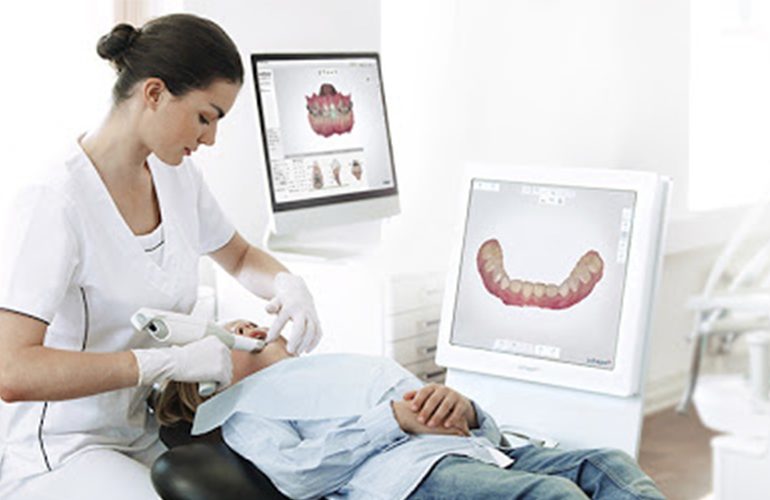
When the scan is completed, the model is examined by magnifying it on screen. If the margin has not been read, the inadequate area is rescanned in the same session. In the conventional method, this deficiency was often noticed in the laboratory.
Elimination of Deformation
Risks such as the physical mold stretching when removed, being damaged in transit or the plaster breaking do not exist with digital data.
Digital Recording of the Bite
The relationship between the two jaws is recorded digitally and contact points are checked in the software during the design stage. This helps reduce the likelihood of the restoration being too high.
Design Approval
The dentist’s review of the design before production allows a problem to be noticed before a physical part is produced.
Interim Verification Steps
In comprehensive cases, interim verification stages can be planned before moving to the permanent restoration. A try-in structure produced from the digital data is tried in the mouth and fit, bite and aesthetics are evaluated. A problem noticed at this stage can be corrected before the permanent material is produced. This step, which at first glance looks like an additional appointment, often prevents two or three appointments later.
Clinical Steps That Shorten the Process
As much as the digital infrastructure, the correct sequence is decisive. At our clinic, we do not skip these steps: first establishing gum health, exposing the margin if necessary, shaping the gum with a well-fitting temporary restoration and verifying the bite record. At first glance these steps seem to lengthen the process; in fact, they shorten the total time by preventing later repetitions.
What Is Done If My Crown Is Too High?
With a newly placed restoration, a slight difference may be felt in the first days. However, if you feel a distinct contact when biting, discomfort when chewing or sensitivity develops in that tooth, do not wait. A restoration that is too high can place excessive load on the tooth, supporting tissue and jaw joint. This is usually a situation resolved in a short check-up session.
Planning for Patients from Abroad
For our patients with limited time, we place the try-in stages in the schedule from the start. Preparing the digital design in advance supports moving directly to the application stage when you arrive. Nevertheless, we do not promise that every treatment can be completed in a single day; a realistic timeline is always better than a rushed treatment.
Frequently Asked Questions
Yes. The fit of your existing prosthesis is also evaluated; in some cases the old prosthesis is used as a reference.
It may be possible in some selected cases; however, more than one session is needed in comprehensive work.
The duration varies according to the production stages and the scope of the case; it is communicated to you during planning.
To verify fit, bite and aesthetics inside the mouth. The try-in is the quality control stage of the process.
No. A correction request shows that control is working and is in the patient’s interest.
Tissue change can affect fit. For this reason, establishing gum health before the impression is given importance.
It varies according to the scope of the case; after planning, the estimated number is communicated to you.
Repeated appointments are not your destiny.
If you have experienced a prosthesis or crown fit problem before, let us investigate the cause together. Contact us to book an appointment; let us set up the process correctly from the start at DijiDent Oral and Dental Health Polyclinic.
This content is for general information purposes. The treatment process and number of sessions vary from person to person; planning is done by your dentist.