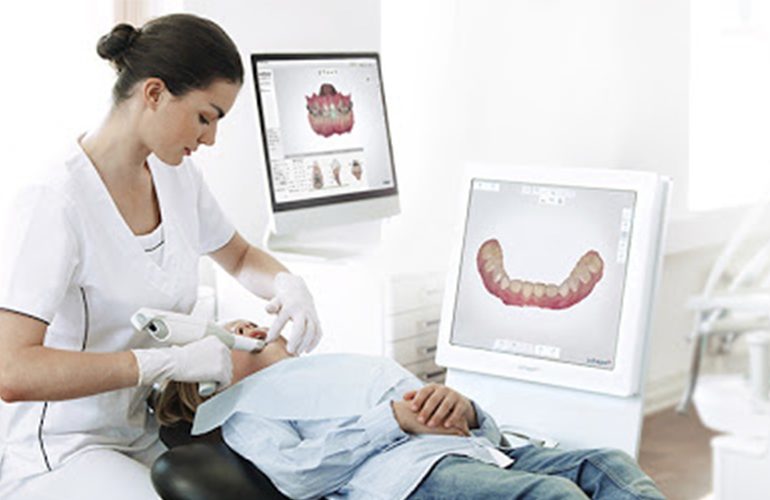
The most critical question in smile design is this: can the result planned on screen really be applied in the mouth? A study done only on a photograph can be visually impressive; however, if it does not take into account the real position of the teeth, the remaining tooth tissue and the bite relationship, its feasibility is questionable. When digital smile design is combined with impression data, the design stops being a visualization and becomes a feasible plan. As DijiDent Oral and Dental Health Polyclinic, in Türkiye we base aesthetic planning on this foundation.
Which Data Come Together?
- Intraoral scan: A true-to-size three-dimensional model of the teeth and gums.
- Facial photographs: Rest, smile and full-smile positions.
- Video recording: Tracking lip movement while speaking and laughing.
- Bite record: How the jaws close together.
- Radiological images: Evaluation of bone and root structure when necessary.
These data are aligned in the software environment. In this way, the tooth model is positioned in the correct relationship with your face, and the design is built according to your facial proportions.
How Is the Design Built?
Planning is not an arbitrary drawing. The width-to-length ratios of the teeth, midline position, the relationship of the smile line with the lip, gum level and the transitions between teeth are evaluated. These criteria are considered together with your own facial proportions; the same standard form is not applied to everyone. Our aim is a result that looks like it belongs to your face.
The Critical Stage: Transferring the Design to the Mouth
When the design is approved, a transfer template is produced from the model. With the help of this template, a temporary material is applied over your teeth without any preparation. This application is called a trial or mock-up. What you see in the mirror at that moment is no longer an image on a screen but a preview of the result in your own mouth. You talk, smile and have photographs taken.
The most valuable aspect of this stage is that it is reversible. If the teeth are too long, the form did not meet your expectations or you felt discomfort while speaking, no permanent procedure has yet been done. Revision is made at this point.
What Changes Regarding Tooth Preparation?
The mock-up application is not just an aesthetic trial; it also serves as a clinical guide. When preparation is done while the targeted form is in the mouth, how much structure will be removed from the tooth is determined by taking this form as a reference. This approach helps prevent more tooth tissue than necessary from being removed. At our clinic, our priority is to reach the goal with the least possible intervention.
Function Is as Important as Aesthetics
Aesthetic planning is not only about how the teeth look. New tooth forms also affect the formation of speech sounds and the distribution of chewing forces. This is why we evaluate how your speech is affected at the trial stage. In addition, in patients with a teeth clenching habit, the design is planned taking these forces into account, and when necessary a protective night guard becomes part of the process.
Not Every Smile Design Means Crowns
Digital planning sometimes shows that the result can be achieved without crowns. There are cases where the goal can be reached with orthodontic movement, gum level adjustment, whitening or composite applications. This is also one of the concrete benefits of the design: it makes visible which treatment is truly necessary.
For Patients from Abroad
When your records are shared in advance, the design can be prepared and the trial stage can be moved to directly when you arrive. However, the final decision is made after the clinical examination; gum health or bite problems may change the scope of the plan.
Frequently Asked Questions
Sharing examples of smiles you like and dislike helps. Concrete references give clearer guidance than verbal descriptions.
No. The trial stage is for you to evaluate the result in your mouth before making a decision.
Yes, we recommend it. Photographs taken in different lighting conditions help you make your decision calmly.
The trial can be applied without preparation, and the temporary material is removed afterwards.
A revision is made. It is essential to reach an agreement before moving to permanent procedures.
That is the goal; however, small differences may occur due to biological and technical factors. This is discussed from the start.
It varies according to the scope of treatment. The process is shorter in cases where only restoration is planned.
Try your new smile before any permanent procedure.
Let us prepare a personalized design with your digital records and evaluate the result together. Contact us to book an appointment; let us create your plan at DijiDent Oral and Dental Health Polyclinic.
This content is for general information purposes; results vary from person to person. The appropriate treatment option is determined with a dentist’s examination.