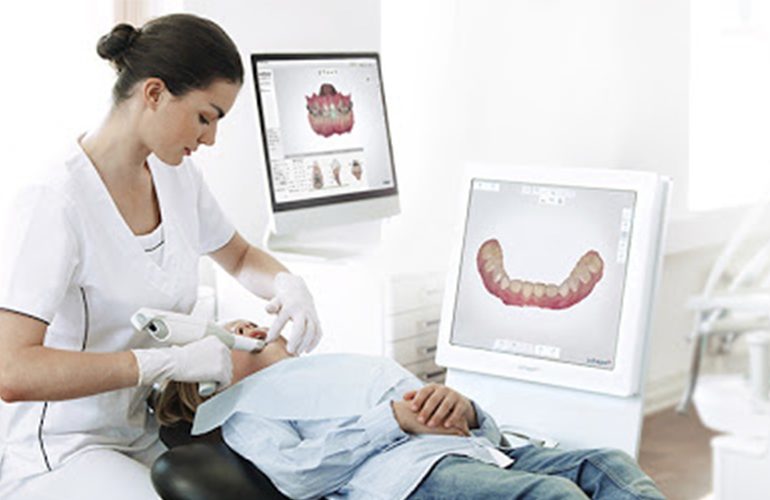
As digital dentistry has spread rapidly, it has also brought information pollution with it. Some promises portray the technology as more powerful than it is, while some reservations create unnecessary hesitation. Misconceptions about intraoral scanners can lead patients both to experience unnecessary anxiety and to develop false expectations. As DijiDent Oral and Dental Health Polyclinic, we have compiled the misconceptions we encounter most often for our patients in Türkiye.
“The scanner emits radiation”
No. An intraoral scanner is an optical device; it works with visible light and involves no ionizing radiation. It should not be confused with X-rays or tomography. For this reason, it can be applied in almost every situation, including pregnancy, and can be repeated as often as desired for follow-up purposes.
“A digital impression is better in every case”
It is advantageous in most cases; however, a claim of superiority without exception is not correct. In completely toothless jaws and in some prosthesis cases where the mobile tissue border needs to be recorded functionally, the conventional method may be preferred. The right approach is to choose the method according to the case.
“The scanner also sees caries”
The scanner records only the surface; it cannot look inside the tooth. Caries developing on interproximal surfaces and under fillings cannot be reliably detected with an optical method. Radiological evaluation is needed for these areas. Having had a scan does not replace a comprehensive caries check.
“Every treatment with a digital impression is finished in a single session”
This is the most common expectation error. In centers with an in-clinic production unit, same-day completion may be possible in selected cases. However, work covering many teeth, cases requiring shade matching in the aesthetic zone and situations where gum healing is awaited naturally take longer.
“If the device is good, the result is good”
Device quality is important but not decisive on its own. Gum health having been established, the margin being made visible, moisture control, correct scanning technique and the accuracy of the bite record affect the result at least as much as the device. When choosing a clinic, the question to ask should not be “which device do you have” but “how is the process carried out.”
“The digital method increases the treatment fee”
The main factors determining the fee are the material, the scope of the restoration and laboratory craftsmanship. The impression method is not a decisive item on its own. It is essential that the choice of method be made on clinical grounds.
“Scanning hurts or makes you gag”
Scanning is painless and requires no anesthesia. Patients with a sensitive gag reflex may experience sensitivity in the posterior region; however, since there is no paste and no waiting and the procedure can be divided, it is tolerated much more easily than a conventional impression.
“Plaster models are no longer needed at all”
Physical models can be produced from digital data when necessary, and in some stages such models are still used. Digitalization does not completely eliminate the physical model; it makes it possible to produce one when needed.
“The result I see in the design is guaranteed”
Digital designs and simulations show the targeted result; they are not a guaranteed output. In orthodontic treatment, tooth movements depend on the biological response and patient compliance. In restorative treatments, the material, gum healing and bite relationship affect the result. For this reason, it is correct to regard the design not as a contract but as an agreed-upon goal.
“Digital impressions make no difference in terms of hygiene”
There is actually a difference. In a conventional impression, the physical material coming out of the mouth needs to be disinfected and delivered to the laboratory. In digital scanning, what goes to the laboratory is only a data file. Standard infection control protocols are applied in both methods.
Frequently Asked Questions
Having a scanner does not mean that the entire digital workflow is applied. You can ask which stages of the process are carried out digitally.
Approach statements containing definitive promises with caution. In healthcare, results vary from person to person.
You can ask which method was chosen and why, how many sessions are planned and which stages are required.
The images may belong to selected cases. Your own situation should be evaluated with an examination.
No. Successful treatments are also carried out with conventional methods; what is decisive is the clinical approach.
Getting a second opinion is your right. You can request your records and ask for a different evaluation.
Accurate information is the first step to the right decision.
Contact us to book an appointment to find out which method is suitable for your treatment and how the process will work. Let us answer your questions openly at DijiDent Oral and Dental Health Polyclinic.
This content is for general information purposes. Method selection and the treatment plan are determined by your dentist after the clinical examination.