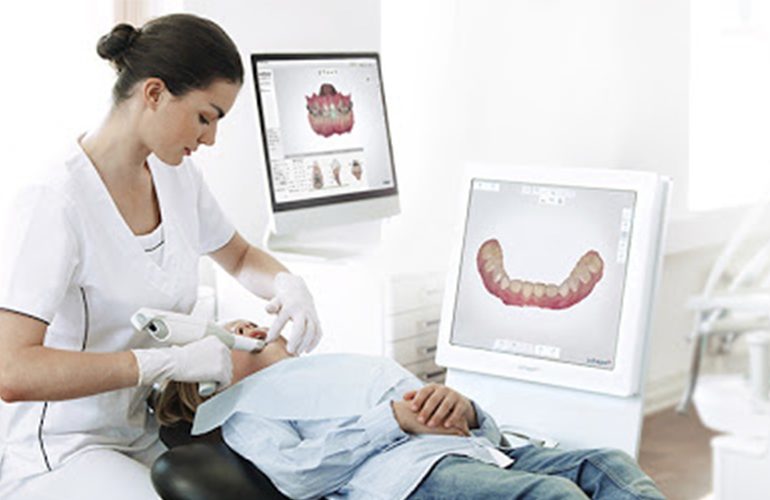
Most patients do not know what happens after the impression is taken from their mouth. However, the fit of your crown or prosthesis depends not only on the time spent in the clinic but also on the stages carried out in the laboratory. Dental laboratory communication has changed significantly with the digital workflow. As DijiDent Oral and Dental Health Polyclinic, at our clinic in Türkiye we carry out this process transparently and explain to our patients how their teeth are produced.
What Happened in the Conventional Process?
In the traditional method, the impression mold was physically delivered to the laboratory. There were several risk points in this process: the mold being damaged in transit, dimensional differences that could occur during plaster pouring, breakage of the model and transport time. In addition, the dentist’s requests had to be conveyed with a written form; any point that was not understood was resolved through phone calls.
How Does the Digital Workflow Work?
- Instant transfer: When the scan is completed, the file is sent to the laboratory within seconds. Shipping time is eliminated.
- Additional layers of information: Shade records, clinical photographs and the dentist’s notes are sent with the same file.
- Design approval: The laboratory sends the design it has prepared to the dentist; production does not start until it is approved.
- Production: The approved design is produced by milling or three-dimensional printing.
- Archive: Since the data is stored, it can be reused when renewal is needed in the future.
Why Is the Approval Stage Important?
The dentist’s review of the digital design is the quality control point of the process. The crown’s margin, thickness, relationship with neighboring teeth and occlusal contacts are evaluated at this stage. When a problem is noticed before production, it is easy to correct; when it is noticed after production, the process starts over. For this reason, we do not skip the approval stage.
Production Methods
The digital design becomes physical in two basic ways. In the milling method, the desired form is cut from ready-made blocks; it is widely used in zirconia and ceramic restorations. In three-dimensional printing, the material is built up layer by layer; temporary restorations, models and surgical guides can be produced with this method. Which method will be used depends on the type of restoration and the material chosen.
What Determines Production Time?
The question “why is it delayed?” that our patients frequently ask has more than one answer. The scope of the restoration is the most decisive factor: a single crown and a full-arch restoration cannot be produced in the same time. Material choice is also influential; some ceramic applications require layered craftsmanship and repeated firing. In work done in the aesthetic zone, achieving the color and surface texture takes additional time. In addition, adjustments made at the try-in stage can extend the process; however, this is a necessary stage in terms of treatment quality.
How Is Shade Matching Achieved?
Color is one of the most challenging topics in the digital workflow. The color seen on screen and the perception of color in the mouth can differ depending on lighting conditions. For this reason, clinical shade measurement and photographs are used alongside digital records. In the aesthetic zone, an additional shade evaluation is carried out at the try-in stage when necessary. This is not a delay; it is a step needed for naturalness.
Collaboration Between the Dentist and the Technician
The quality of the restoration is the joint product of two areas of expertise. The dentist knows the conditions inside the mouth, the patient’s expectations and the bite relationship; the dental technician knows the behavior of the material and the limits of production. In the digital environment, these two bodies of knowledge meet on the same file. Being able to leave mutual notes on the design significantly reduces the loss of information seen in the conventional method.
What Does It Mean for the Patient?
The digital workflow makes the process more predictable. The risk of your impression being lost or damaged decreases, unnecessary repeat appointments become less frequent and your data is archived. When your crown needs to be renewed years later, the previous design can be used as a reference.
Frequently Asked Questions
Design and production are carried out at the dental laboratory the clinic works with. You can get information about the process from your dentist.
Sharing is done for treatment purposes and within the framework of the relevant legislation. You can request detailed information about the process.
It speeds up the transfer and design stages; however, the total time depends on the scope of the restoration.
No. Requesting a correction in terms of fit or aesthetics shows that quality control is working.
In many cases, it is possible. You can ask your dentist to share the design with you.
Records are archived within the framework of the relevant legislation and shared with you upon request.
You have the right to know every stage of your treatment.
Get detailed information about the process, estimated duration and stages of your planned restoration. Contact us to book an appointment; let us explain the process from start to finish at DijiDent Oral and Dental Health Polyclinic.
This content is for general information purposes. Production times vary according to the case and material; planning is done by your dentist.