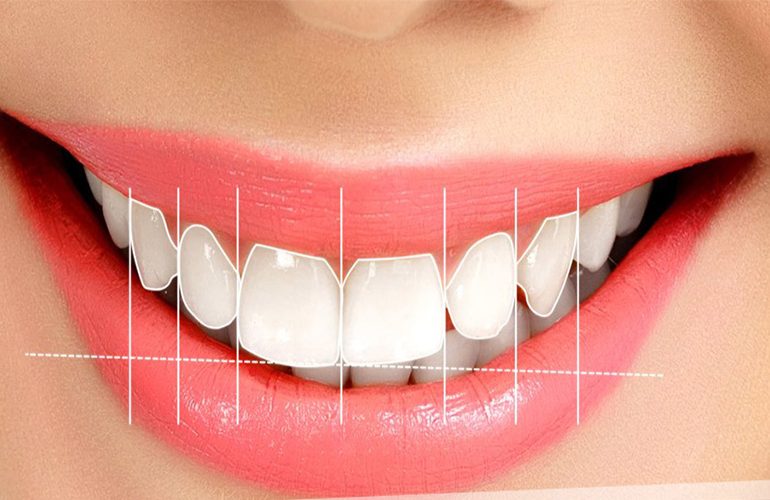
Two smile designs made at the same clinic with the same method can turn out completely different from each other, and this is how it should be. In aesthetic dentistry there is no standard goal; what should happen is that the result looks like it belongs to the person. Personalized smile design begins with preferences being correctly understood. As DijiDent Oral and Dental Health Polyclinic, in Türkiye we devote the longest part of the design process to listening to you.
Factors That Shape Preferences
Facial Features
When the face form is in harmony with the tooth form, the smile is perceived as balanced. In a face with rounded contours, angular teeth with sharp transitions may draw attention, while in a face with pronounced contours, very soft forms may look faint. This is not a rule but a starting point.
Age
In young teeth, the incisal edges are more pronounced, the surface texture more expressive and the translucency greater. Over the years, the edges soften and slight wear forms. This change is taken into account in aesthetic planning; in an older patient, completely flat, sharp-edged teeth can create a contrast that does not harmonize with the face. The aim is not to hide age but to present the smile in a natural whole.
Personal Expectations
This is the most decisive factor. Some patients want an eye-catching, pronounced smile; others say “it shouldn’t look like I’ve had treatment.” Both expectations are legitimate and the design is structured accordingly. A mistake frequently encountered in the sector is the dentist adapting their own aesthetic understanding to the patient.
The Limits of Generalizations
The literature describes tendencies showing that certain form preferences are seen more often in certain groups. However, these are statistical tendencies, not rules. At our clinic, no patient is recommended a form based on the group they are assumed to belong to. What is decisive is your face and your preference.
Profession and Lifestyle
Your daily life can also affect your preferences. The priorities of a person who works in front of a camera or gives frequent presentations differ from those of a person who does physical work. In patients who play contact sports, durability and protective measures come to the fore; for those who are on stage or on screen, appearance under lights is decisive. Sharing this information ensures that the plan suits you not only aesthetically but also practically.
How Should You Describe Your Expectations?
- Bring images: Examples of smiles you like are much clearer than verbal descriptions.
- Also show what you do not like: Knowing what you do not want is at least as valuable as what you want.
- Specify which feature you like: The length, the form or the color? This distinction directly guides the design.
- Share your old photographs: Your own tooth form before wear is a strong reference.
- Describe your daily life: Your profession, social environment and habits can affect the decision.
Three Basic Tendencies of Tooth Form
Tooth forms are generally considered in three groups: angular with straight edges, oval with soft transitions, and close to triangular with a narrowing neck area. These groups are a convenience of classification; in practice, most teeth are a mix of these forms. Which tendency will come to the fore in the design is determined together with your facial features and preference. No form is superior to another.
The Different Meanings of the Word “Natural”
Most patients want a natural result; however, this word does not mean the same thing to everyone. For some, natural means preserving slight irregularities; for others, it means a straight but understated alignment. The trial stage eliminates this ambiguity: instead of an abstract word, you get a concrete image that has been agreed upon.
The Opinion of Those Close to You
Having someone with you during the trial is helpful; it takes time to get used to the change in our own face. However, the decision is yours. When you are caught between different opinions, we remind you that you do not have to decide on the same day; taking photographs and thinking for a few days is the healthiest way.
Frequently Asked Questions
With the right approach, no. The design is structured according to your facial proportions and expectations.
No. Visual references and the trial stage help you clarify your expectations.
Tooth length, edge form and shade selection are determined by evaluating them together with your face.
No. Your dentist explains the clinical limits; the aesthetic preference is yours.
No. It is recommended that you take time to think.
Your smile should look like you.
Let us clarify your expectations together and prepare a personalized design. Contact us to book an appointment; let us start by listening to you at DijiDent Oral and Dental Health Polyclinic.
This content is for general information purposes; aesthetic results vary from person to person. Planning is done with a dentist’s examination.