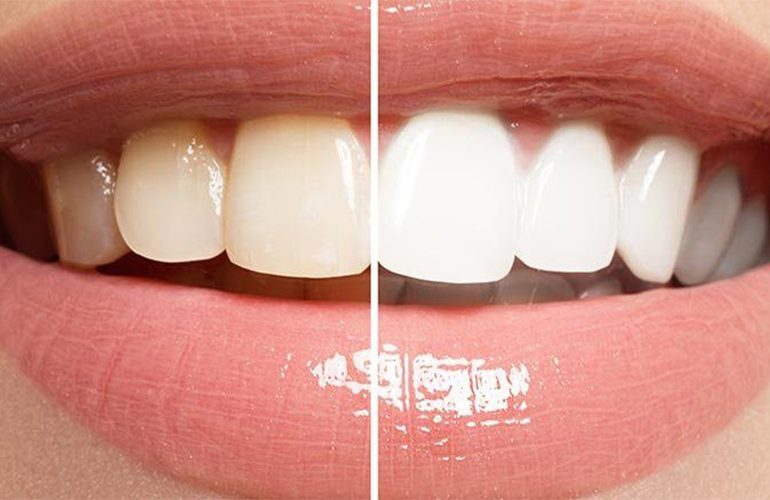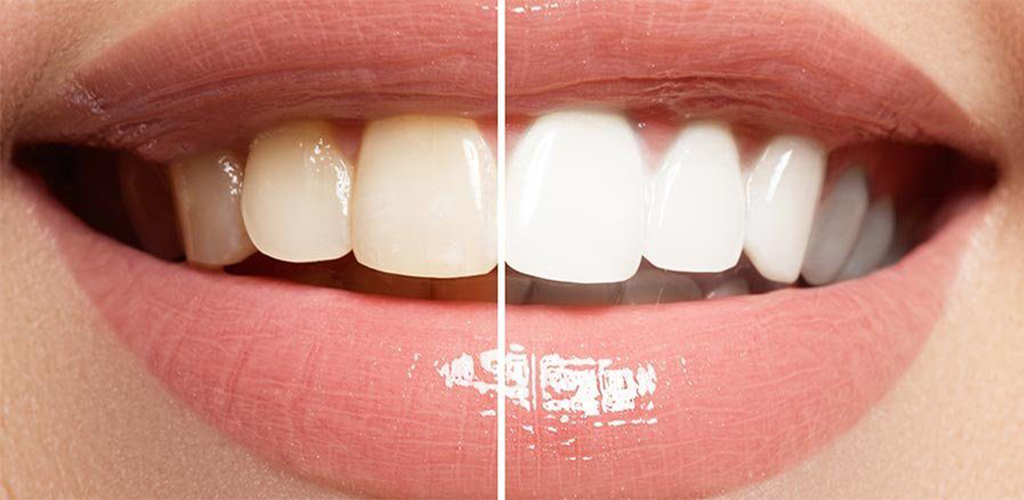
One of the first questions faced by patients considering teeth whitening is which method is suitable for them. The two basic methods applied under a dentist’s supervision are in-office whitening done in the clinic and at-home whitening applied at home with custom trays. Both methods can be effective; however, they differ in terms of duration, comfort, sensitivity and compatibility with lifestyle. Knowing the differences between in-office and at-home whitening allows you to make the choice best suited to your expectations and needs. As DijiDent Oral and Dental Health Polyclinic, we offer both methods to our patients in Türkiye under a dentist’s supervision.
In-Office Whitening
How Is It Applied?
The procedure is done in the clinic under the dentist’s supervision. First, the color of the teeth is measured and recorded. The gums are covered with a protective barrier that prevents contact with the whitening gel. Then a high-concentration whitening gel is applied to the front surfaces of the teeth and renewed several times for set periods. Light sources may also be used in some systems. At the end of the procedure, the color is measured again and the result is evaluated.
Advantages
- Fast results: A marked lightening of color can be achieved in a single session.
- Dentist supervision: The entire process takes place in the clinic under professional supervision.
- No compliance required: There is no responsibility for regular use at home.
Limits
- Sensitivity: Because of the high concentration, temporary sensitivity after the procedure may be more pronounced.
- Clinic time: A single session can take a few hours; the mouth needs to be kept open.
- Longevity: At-home support may be recommended to maintain a result achieved in a short time.
At-Home (Dentist-Supervised) Whitening
How Is It Applied?
First an examination is done, and impressions of your teeth are taken to prepare custom clear whitening trays. Your dentist explains in detail how to place the lower-concentration whitening gel in the tray and how long to use it. The trays are generally used for certain hours a day or overnight for a few weeks. Throughout the process, the result and sensitivity are followed up with check-up appointments.
Advantages
- Gradual and controlled result: Since the color lightens gradually, you can stop when the desired shade is reached.
- Less sensitivity: Because of the low concentration, sensitivity is generally milder.
- Flexibility: You can apply it according to your own schedule.
- Reusable trays: The trays can be kept for future touch-up applications.
Limits
- Longer duration: Results appear within a few weeks.
- Requires regular use: Success depends on following the recommended durations.
- Getting used to the tray: Some patients may have difficulty getting used to using the tray in the first days.
In both methods, the aim is to achieve a natural and balanced lightening of color while protecting the health of the teeth; the choice of method is about determining the path best suited to this aim.
Which Method Suits Whom?
- Those who want results in a short time: In-office whitening or the combined method.
- Those prone to sensitivity: At-home whitening can generally be more comfortable.
- Those who want gradual and controlled change: At-home whitening.
- Those aiming for long-term maintenance: Periodic touch-up applications with at-home trays.
- For the best result: In some patients, a combined approach that starts with in-office and continues with at-home whitening.
Store-Bought Products and Kits Purchased Online
Whitening toothpastes, strips and whitening kits sold online are not the same as dentist-supervised at-home whitening. Whitening toothpastes are mostly aimed at reducing surface stains. Uncontrolled kits, on the other hand, can lead to the gel overflowing onto the gum, irritation and sensitivity due to ill-fitting trays. In addition, the content and safety of some products may be unclear. It is recommended that a dentist’s examination always be done before whitening.
Common Rules for Both Methods
- Preliminary examination: Caries, gum disease and the causes of sensitivity are evaluated.
- Professional cleaning: Tartar and surface stains are cleaned first.
- White diet: Avoiding coloring foods and drinks during and immediately after the whitening process is recommended.
- Sensitivity management: Your dentist recommends desensitizing products when necessary.
- Realistic expectations: The result varies from person to person and a specific shade cannot be guaranteed.
About Light-Activated Systems
Light sources are used in some in-office whitening systems. There are differing views on the contribution of light to the whitening result, and the main factors determining the result are the type and concentration of the whitening gel used and the application time. For this reason, when choosing a method, dentist supervision and a protocol suited to the person matter more than whether light is used.
Let Us Decide Together
At DijiDent, before whitening, we measure the color of your teeth, evaluate the cause of the discoloration and, taking into account your lifestyle, sensitivity status and expectations, determine together the method most suitable for you.
Frequently Asked Questions
Both can be effective. In-office provides faster results, at-home provides more gradual results.
A single session usually takes a few hours; an additional session can be planned if necessary.
Generally a few weeks of regular use is required; the duration is determined by the dentist.
Because of the low concentration, at-home whitening generally causes less sensitivity.
Uncontrolled kits can lead to irritation and sensitivity; a dentist’s examination is recommended.
Let us choose the whitening method that suits you together.
Contact us to book an appointment to evaluate your in-office and at-home whitening options. Let us create your personalized plan by carrying out your color analysis at DijiDent Oral and Dental Health Polyclinic.
This content is for general information purposes and does not replace an examination by a dentist. Whitening results vary from person to person; a specific color result cannot be guaranteed.