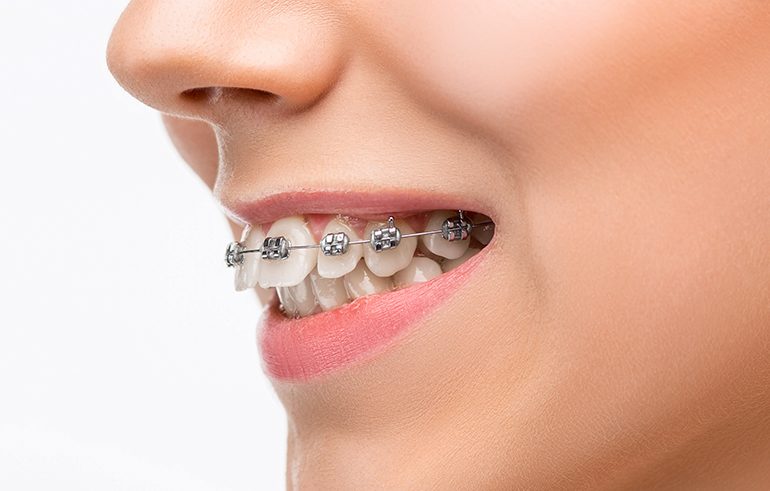
It is a common belief that orthodontics is only for children and teenagers. Yet tooth movement is related not to age but to the health of the tissues. As long as the bone and gums are healthy, teeth can be moved in a controlled manner at any age. Today, adult orthodontics makes up an important part of clinical practice. As DijiDent Oral and Dental Health Polyclinic, in Türkiye we plan treatment for our adult patients while taking into account the specific conditions of this age group.
Why Is Treatment Different in Adults?
In children, since jaw development continues, the orthodontist can guide this growth. In adults, growth is complete; therefore, changing the jaw relationship may not be possible just by moving the teeth. In pronounced skeletal discrepancies, a surgically assisted plan comes into consideration.
Apart from this, the speed of movement may be somewhat slower in adults and the adaptation process of the tissues is different. This does not mean that the treatment cannot be applied; it is a fact that affects the duration and planning.
The Most Important Prerequisite: Gum Health
This topic is at the center of adult orthodontics. Orthodontic force applied in a mouth with advanced gum disease can accelerate bone loss. For this reason, a periodontal evaluation needs to be done before treatment. If there is gum disease, it is treated first, and orthodontics begins after the tissue has become stable.
In patients with gum recession, whether the planned movement will push the limits of the bone is evaluated in advance. In some cases, three-dimensional imaging contributes to this evaluation. At our clinic, we do not skip this step; because the aim of orthodontics is to protect the teeth as much as to straighten them.
Situations Commonly Encountered in Adults
- Late crowding: Crowding that increases with age, especially in the lower front region.
- Relapse: Teeth that have moved back because a retainer was not used after childhood treatment.
- Shifting after tooth loss: Teeth that tilt and elongate into the gap.
- Bite changes due to wear: The long-term effects of a teeth clenching habit.
- Preparation before a prosthesis: Creating suitable space for an implant or bridge.
Orthodontics Before a Prosthesis
This is an approach frequently applied in adults. In an area that has been empty for a long time, the neighboring teeth may have tilted or the opposing tooth may have elongated. In this case, placing an implant or bridge directly produces an ill-fitting result. Limited orthodontic preparation brings the teeth into the correct position and allows a more conservative and better-fitting restoration to be made.
Evaluation of Root Resorption
During orthodontic movement, shortening of the root tips may be seen in some patients. This risk is evaluated separately in adults; in patients with thin or short root structures, the force level and treatment duration are planned accordingly. Radiological records taken before treatment and, when necessary, during the interim period support the safe progress of the process.
The Concern About Visibility
This is the reservation most frequently raised by our adult patients. Today there are several options: clear aligners, ceramic brackets and lingual systems applied to the back surface of the teeth. Which one is suitable depends on the complexity of the case; not every option can be applied in every case. However, there is no need to give up treatment completely because of the concern about visibility, since an alternative can be found in most cases.
Duration Expectation
In adults, the treatment duration varies significantly according to the case. A limited alignment and a comprehensive bite correction are not completed in the same time. It is a process that requires patience; however, the progress seen in interim stages supports motivation. Superimposing digital scan records allows you to see progress concretely.
Retention Is Mandatory
Retention after treatment is essential in adults too. The forces exerted by the lip, cheek and tongue muscles continue throughout life; in addition, a natural tendency to crowding is seen with age in the lower front region. For this reason, retainer use is planned for the long term.
Frequently Asked Questions
What is decisive is not age but gum and bone health.
A periodontal evaluation is done first; suitability is determined accordingly.
If a retainer was not used, relapse may occur. A re-evaluation is recommended.
Less noticeable options can be considered; suitability depends on the case.
Since it preserves tooth tissue, it is evaluated as a priority in many cases.
You are not too late for orthodontics.
Your gum health and case are evaluated and the option that suits you is determined. Contact us to book an appointment; let us create your plan at DijiDent Oral and Dental Health Polyclinic.
This content is for general information purposes. Suitability and treatment duration are determined after clinical and radiological evaluation.