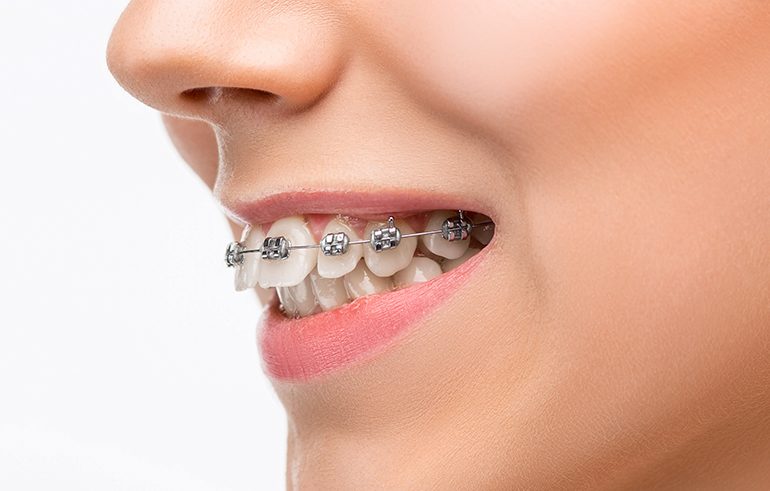
When the braces are removed, many patients want to complete their smile, and the first thing that comes to mind is whitening. This wish is understandable; however, timing and a preliminary evaluation directly affect the quality of the result. Whitening after orthodontics gives good results when applied under the right conditions; when done hastily, it may not meet expectations. As DijiDent Oral and Dental Health Polyclinic, in Türkiye we inform our patients realistically on this subject.
Why Is It Not Done Immediately?
During the removal of the brackets and the cleaning of adhesive residue, the tooth surface undergoes a mechanical process. In this period, the enamel surface may be temporarily more sensitive. In addition, the surface needs to be completely cleaned and polished; otherwise, the remaining residue prevents the whitening from spreading evenly.
For this reason, the application is planned not immediately after removal but after the surface condition has been evaluated and a short time has passed. Your dentist will tell you the appropriate timing.
White Spots: The Most Important Issue
This section should be read carefully. The chalky white spots that form around the brackets during treatment are early caries lesions. The expectation that these spots will be covered by whitening is common; however, the reality is the opposite.
Whitening lightens the overall tone of the tooth; however, since the spot area also lightens along with it, the contrast may not decrease and may even look more pronounced in the initial period. Over time, as the tooth as a whole takes on color, the difference may decrease somewhat; however, this is not a predictable result.
Different approaches are evaluated for white spots: applications that support remineralization, surface infiltration techniques or limited restorative solutions. Which one is suitable depends on the depth of the spot. For this reason, the spots need to be evaluated separately before whitening.
Is Whitening Done During Treatment?
Whitening is not recommended while fixed orthodontic treatment is ongoing. The surfaces under the brackets are not affected by the procedure; as a result, when the brackets are removed, darker areas appear underneath and an uneven appearance forms.
The situation is different in clear aligner treatment. In some cases, your dentist may include whitening in the plan at a suitable stage of treatment. This decision is individual and depends on the structure of the aligners; it is important that you do not apply it on your own decision.
Its Relationship with the Retainer
In patients with a fixed retainer wire, the surfaces behind the wire may not be affected to the same degree by the whitening gel. This does not create a noticeable difference on the front surfaces; however, your dentist needs to evaluate it. Removable retainers, on the other hand, can be used as a whitening carrier in some cases; this use should be on your dentist’s recommendation.
Sensitivity
In some patients, there is temporary sensitivity in the teeth after orthodontic treatment. Since whitening can also cause sensitivity on its own, timing is important so that these two situations do not overlap. If you have a sensitivity complaint, you need to mention it; the intensity and duration of the application can be adjusted accordingly, and supportive applications can be planned beforehand if necessary.
If You Have Restorations
Composite fillings, laminates or crowns are not affected by whitening. When the natural teeth become lighter, these restorations may remain darker and may need to be renewed. For this reason, your existing restorations are evaluated when the whitening decision is made; planning is done according to this sequence.
Which Method Is Applied?
Whitening can be done with methods applied in the clinic, with methods applied at home with custom-made trays, or with a combination of the two. In patients after orthodontics, the use of the existing retainer or the preparation of a new carrier is considered. Which method is suitable is determined according to the type of discoloration, your sensitivity and the targeted shade.
Recommendations for Afterwards
In the first days after whitening, it is recommended that you stay away from dark-colored foods and drinks. Preserving the result achieved depends on oral care, consumption habits and regular check-ups. The result is not permanent; over time the color returns somewhat, and support applications can be planned when necessary.
Frequently Asked Questions
A short wait is usually recommended; your dentist will specify the appropriate time.
Whitening does not eliminate these spots; a separate evaluation and different approaches are needed.
If intervened in early, their progression can be stopped; there are different options for marks that have already formed.
When applied under a dentist’s supervision, it is generally safe; sensitivity may be seen temporarily.
It varies according to the person and habits; indefinite permanence cannot be promised.
Have the right evaluation before completing your smile.
Let us determine together the right time for whitening and the condition of any spots. Contact us to book an appointment; let us create your plan at DijiDent Oral and Dental Health Polyclinic.
This content is for general information purposes; results vary from person to person. The application should be carried out under a dentist’s supervision.