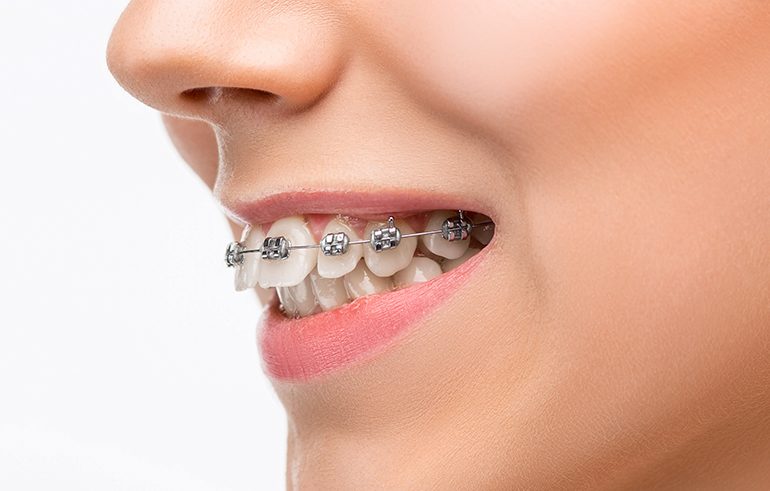
When the braces are removed, the treatment seems to be over and most patients feel relieved. Yet one of the most critical stages of orthodontic treatment begins precisely at this point. Even if the teeth settle into their new positions, the fibers and bone tissue surrounding them need time to adapt to this position. The orthodontic retention stage ensures that the result achieved is preserved. As DijiDent Oral and Dental Health Polyclinic, in Türkiye we consider this stage an integral part of the treatment.
Why Is It Necessary?
Teeth are attached to the bone by means of periodontal fibers. During orthodontic movement, these fibers are stretched and it takes months for them to adapt to the new position. During this process, the fibers tend to pull the tooth back towards its old position.
In addition, the forces exerted by the lip, cheek and tongue muscles continue throughout life. There is also a natural tendency to crowding in the lower front region with age; this is a condition also observed in people who have never had orthodontics. In short, retention is applied not because the treatment has failed, but as a requirement of biology.
Types of Retainers
Fixed Retainers
They usually consist of a thin wire bonded to the back surface of the front teeth. It is not visible from the outside and does not depend on patient compliance; it is always on duty. This is its greatest advantage. On the other hand, its cleaning requires care: an interdental brush and special floss that can be threaded under the wire should be used. Since tartar build-up may be seen in this area, professional cleaning intervals are planned closer together.
Removable Retainers
Clear retainers or classic retainer types are in this group. They are put in and taken out by the patient; cleaning them is easy. However, success depends directly on wearing discipline. While an unused retainer waits in a drawer, the teeth move, and after a while the retainer no longer fits.
In practice, the most frequently applied approach is a combination: for example, a fixed wire in the lower jaw and a retainer worn at night in the upper jaw.
How Long Is It Used?
It is necessary to be realistic about this. Retention is not a period limited to a few months. Today, the common approach is to maintain protection over the long term, even if the frequency of use is reduced over time. Use that is more intensive at the beginning is gradually reduced with your dentist’s evaluation.
The honest answer to the question “When can I stop completely?” is this: since the tendency of teeth to move continues throughout life, some protection is recommended over the long term. This does not mean wearing a retainer every night; your dentist determines a routine suitable for you.
The First Months Are the Most Critical Period
The first months after the braces are removed are the period when the tendency to relapse is highest. For this reason, retainer use is planned more intensively at the beginning. Some patients relax precisely in this period and neglect wear; yet this is the time when they need to be most careful.
If the Retainer Wire Comes Off
When one end of the fixed retainer comes loose, go to the clinic without losing time. A detached wire not only loses its function; since it holds on at a single point, it may create unwanted movement in that tooth. This is a situation that should not be postponed. Likewise, if there is a sharp end of the wire that your tongue notices, a check-up is needed.
If Your Retainer Does Not Fit
If your retainer fits with difficulty or does not fit at all after not using it for a while, do not force it. This shows that the teeth have moved. Go to the clinic; the situation is evaluated and a new retainer is produced if necessary. If there is a digital scan record in the archive, the process may be faster.
Care and Check-Ups
Removable retainers should be cleaned every day with cold water and a soft brush and stored in their case without being left dry. Hot water distorts their shape. In those who use a fixed retainer, interdental cleaning should not be neglected.
Check-up appointments continue throughout the retention period. In these check-ups, the integrity of the wire, the fit of the retainer and the position of the teeth are evaluated. Abandoning check-ups completely because the treatment is over is the most common mistake.
Frequently Asked Questions
The likelihood of the teeth moving back towards their old positions increases; the treatment may need to be repeated.
It varies according to the case; they are often planned together.
A slight difference may be felt in the first days; people usually get used to it in a short time.
Go to the clinic without waiting. Delay may lead to the teeth moving.
It does not itself; however, if the area around it is not cleaned, plaque accumulation and the risk of caries increase.
Preserving the result of your treatment is as important as the treatment.
If your retainer has come off or been lost, or your retainer does not fit, do not wait. Contact us to book an appointment; let us review your retention plan at DijiDent Oral and Dental Health Polyclinic.
This content is for general information purposes. The type of retainer and the duration of use are determined individually by your dentist.