Having straight teeth is not only a matter of how the smile looks. The spaces between overlapping teeth cannot be fully cleaned with a brush; caries and gum problems develop more easily in these areas. A faulty bite may lead to strain on the jaw joint and wear on certain teeth. Orthodontic treatment aims to improve both function and appearance by moving the teeth and the jaw relationship into the correct position with planned forces. As DijiDent Oral and Dental Health Polyclinic, in Türkiye we plan this treatment with digital records.
How Do Teeth Move?
A tooth is not a structure fixed rigidly inside the bone; it is attached to the bone by means of the periodontal fibers around it. When a continuous, light force is applied to the tooth, the bone on the pressure side remodels and new bone forms on the tension side. In this way, the tooth gradually changes position within the bone.
This process is biological and cannot be accelerated. Applying excessive force does not speed up movement; on the contrary, it can damage the root structure and increase pain. This is why orthodontics requires patience.
Which Problems Are Treated?
- Crowding: The teeth not finding enough space in the jaw.
- Gaps between teeth: The teeth being small relative to the jaw, or missing teeth.
- Deep bite: The upper front teeth covering the lower teeth excessively.
- Open bite: The front teeth not touching each other.
- Crossbite: A reversed relationship between the upper and lower teeth.
- Jaw relationship disorders: The upper or lower jaw being positioned forward or back.
- Impacted teeth: Bringing teeth that have not erupted into the arch.
The Treatment Process
Evaluation and Records
A clinical examination, photographs, a digital impression and the necessary radiological images are taken. These records form the basis of the plan.
Planning
The target tooth positions are determined, whether extraction is needed is evaluated and the options are shared with you.
Active Treatment
The teeth are moved gradually with a fixed or removable system. Check-up appointments are planned at certain intervals.
Retention
The process does not end when active treatment is over. A retainer is used so that the teeth become stable in their new positions. This stage is not optional; when it is skipped, the teeth tend to return to their old positions.
The Main Systems Used
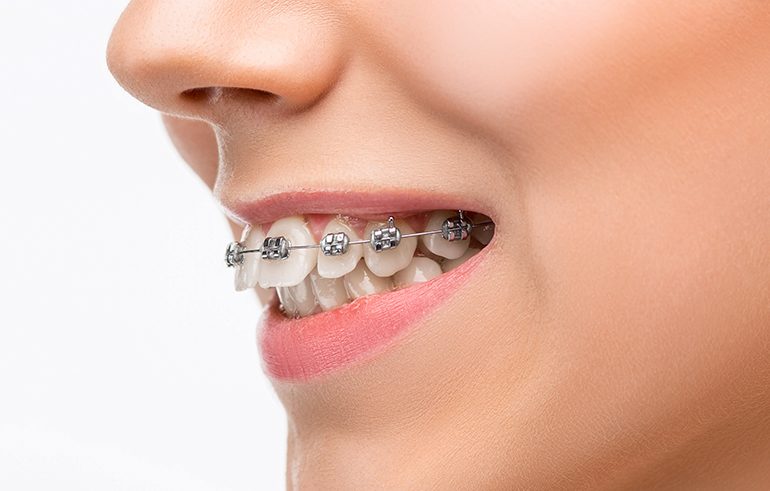
In fixed systems, brackets bonded to the teeth and a wire passing between them are used. In removable systems, clear aligners or certain appliances are preferred. In addition to these, appliances aimed at guiding jaw development and temporary mini-screws placed in the bone to support tooth movement may come into consideration. Which system will be applied is determined according to the type of case; not every system can be applied in every case.
Prerequisites Before Orthodontics
Orthodontic force requires a healthy foundation. Starting movement while there are untreated caries and active gum disease can accelerate the problems. Especially in adult patients, a periodontal evaluation should not be skipped; force applied to inflamed tissue can increase bone loss. For this reason, at our clinic we ensure oral health before starting orthodontics.
What Does the Duration Depend On?
The treatment duration varies significantly according to the complexity of the case, the patient’s age, the type of movement planned and patient compliance. Simple alignment and the correction of a skeletal problem are not completed in the same time. For this reason, a clear duration can only be shared after a detailed evaluation. We recommend that you approach promises of an exact duration with caution.
Oral Care During Treatment
The area around brackets and wires is prone to plaque accumulation. Using an orthodontic toothbrush, an interdental brush and, if necessary, a water flosser is important throughout treatment. In cases where care is neglected, white spots and caries may develop around the brackets; this means ending up with straight but damaged teeth at the end of treatment.
Frequently Asked Questions
Yes. Using a mouthguard is recommended for contact sports; your dentist will specify the suitable type.
No. If gum and bone health are sufficient, it can also be applied in adults.
Sensitivity in the first days after the braces are fitted and tightened is normal; it usually decreases in a short time.
It is not needed in every case. It is evaluated according to the space requirement.
They may if a retainer is not used. Retention is part of the treatment.
It varies according to the system; regular check-ups at certain intervals are usually needed.
The right time for straight teeth is the moment you have the evaluation.
Contact us to book an appointment to find out which approach is suitable for you or your child. Let us carry out your orthodontic evaluation at DijiDent Oral and Dental Health Polyclinic.
This content is for general information purposes. The treatment method and duration are determined by your dentist after clinical and radiological evaluation.