The first question of patients deciding on orthodontic treatment is usually the choice of system. On the internet, one is often presented as superior to the other; yet the right question is not “which is better” but “which is suitable for my case.” The debate of braces or clear aligners can only be conducted meaningfully with clinical criteria. As DijiDent Oral and Dental Health Polyclinic, in Türkiye we make this decision according to the requirements of your case.
Fixed Orthodontic Treatment (Brackets)
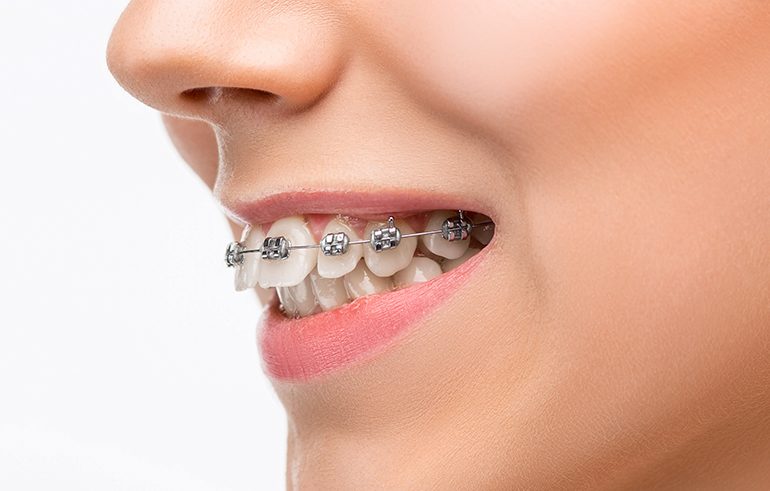
Brackets are bonded to the teeth and controlled movement is provided with a wire passed between them. There are metal and ceramic options; ceramic brackets are less noticeable but more brittle than metal ones. Lingual systems applied to the back surface of the teeth are not visible from outside.
Strengths
- It offers broad control in complex movements.
- It is less dependent on patient compliance; the system is in the mouth all the time.
- It gives more predictable results in root movements and rotations.
- It can be used together with additional appliances in cases requiring skeletal support.
Limits
- Visibility may cause hesitation, especially in adults.
- Cleaning is more difficult; the area around the brackets accumulates plaque.
- Restrictions are needed with hard and sticky foods.
- A bracket coming off may require an extra appointment.
Clear Aligner Treatment
Custom-made clear aligners move the teeth gradually by being changed at certain intervals. Planning is done on a digital model and a treatment simulation is shared in advance.
Strengths
- It is significantly less noticeable.
- Since it can be removed, eating and cleaning become easier.
- No restrictions on diet are needed.
- Situations such as an emergency bracket detachment do not occur.
Limits
- Success depends directly on daily wearing time.
- It may be limited in complex root movements.
- For some movements, attachments need to be bonded to the teeth.
- Losing or forgetting the aligner delays treatment.
The Difference in Terms of Cleaning
In fixed systems, since the area around the brackets accumulates plaque, using an orthodontic toothbrush and an interdental brush is mandatory. In cases where care is neglected, permanent white spots may form around the brackets. With clear aligners, the teeth are brushed normally; however, if brushing is not done before the aligner is put in, food residue remains in contact with the tooth surface for a long time. In other words, care is needed with both systems; only the method is different.
Decision Criteria
System selection is made according to these criteria:
- Complexity of the case: The type and amount of movement are decisive.
- Skeletal component: If the jaw relationship is disturbed, additional approaches may be needed.
- Patient compliance: Will you be able to maintain the discipline of daily wear?
- Age: In children, compliance with removable systems is more variable.
- Lifestyle: Your profession, social environment and travel routine.
- Gum condition: Ease of cleaning may be decisive for some patients.
Being Honest About Compliance
The most common problem in clear aligner treatment is that the aligners are not worn enough. Since aligners are removable, the system is not in the mouth all the time; when the daily wearing time specified by your dentist is not followed, tooth movements do not happen at the planned speed, treatment is prolonged and the plan has to be updated.
For this reason, we recommend that you be honest with yourself at the decision stage. If you have a busy schedule and find regular wear difficult, fixed treatment may be more suitable for you.
Discussing this from the start prevents disappointment in the middle of treatment.
Combined Approaches
The two systems do not have to be alternatives to each other. In some cases, complex movements are first completed with a fixed system, and then clear aligners are used in the finishing stage. Or a fixed system is preferred in only one jaw. This flexibility allows the plan to be shaped according to the case.
Frequently Asked Questions
The system used, the number of aligners, the laboratory process and the treatment duration are decisive; it is not only the name of the system but the scope of the case that affects the price.
No. In complex movements and pronounced skeletal problems, fixed treatment may be preferred.
No. Criteria such as tooth length and bite relationship are decisive; suitability is determined by evaluation.
The duration depends not on the system but on the case and compliance. A general claim of speed superiority is not correct.
There may be a slight difference in the first days; in most patients it passes in a short time.
They are less noticeable; however, they may be more prone to fracture.
It is possible in some cases; your dentist evaluates it.
Let us talk not about the system, but about your case.
Let us determine which approach suits you based on clinical criteria. Contact us to book an appointment; let us compare the options at DijiDent Oral and Dental Health Polyclinic.
This content is for general information purposes. System selection and duration are determined by your dentist after the clinical evaluation.