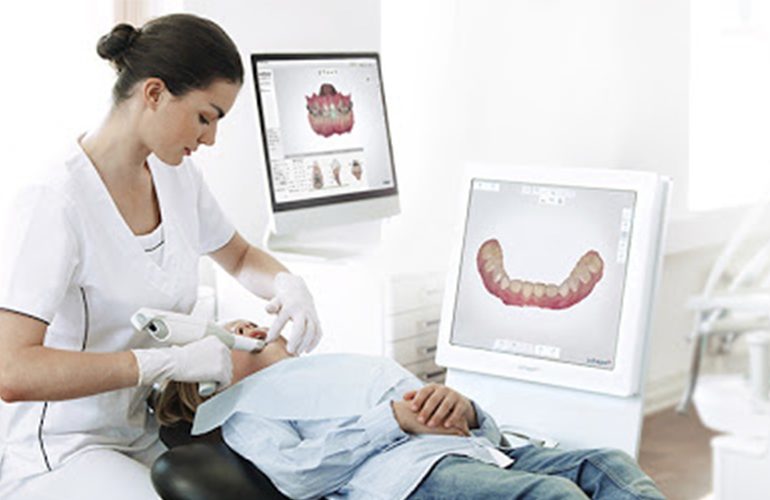
Gum recession is a process that extends over years and often progresses unnoticed. Patients usually come with complaints such as “my teeth look like they’ve gotten longer” or “I’ve started having pain with cold drinks.” The real clinical question, however, is this: has this recession stopped, or is it continuing to progress? Thanks to digital scanning, gum recession monitoring can now be based not on impressions but on measurement. As DijiDent Oral and Dental Health Polyclinic, at our clinic in Türkiye we make this distinction with measurable data.
Why Does the Gum Recede?
- Periodontal disease: The inflammatory process affects the supporting tissue and bone.
- Excessively hard brushing: Incorrect technique and a hard brush mechanically strain the tissue.
- Thin bone and gum structure: In some people, the tissues are structurally thinner.
- Teeth clenching and bite forces: Excessive loading on certain teeth.
- Orthodontic movements: Movements that push the bone boundaries can pose a risk.
- Piercings and habits: Constant mechanical irritation.
Usually, several factors play a role together. For this reason, the treatment plan begins by determining the cause.
The Limit of the Conventional Measurement Method
In a periodontal examination, the amount of recession is measured in millimeters with a fine-tipped probe. This method is reliable and indispensable; however, the pressure applied during measurement, the angle of the probe and taking the measurement from exactly the same point can vary from person to person and from session to session. A half-millimeter difference can be clinically meaningful but is difficult to capture consistently with this method.
The Contribution of Digital Scanning
When two scans taken at different times are superimposed, the change in the position of the gum margin is calculated as a surface difference. The color map shows visually and numerically how much loss there is in which region. Moreover, this measurement is objective data that does not vary from operator to operator. Since the method involves no radiation, it can also be repeated as often as necessary.
What Does Monitoring Change?
The decision process becomes clear here. If there is significant progression between two records taken a year apart, the process is active and intervention should not be delayed. If the loss has stopped, it is understood that the protective measures applied have worked and unnecessary surgery can be avoided. This distinction is an important basis for decision-making for both the patient and the dentist. The question “is it really necessary?” of a patient who has been recommended surgery can only be answered soundly with measurable progression data.
Effect on Patient Behavior
Changing a brushing habit does not always happen with a verbal recommendation. However, when the patient sees the loss in their own gum on the color map, compliance with behavior change increases significantly. This is an effective communication tool, especially in recession due to hard brushing.
Recession and Bone Loss Are Not the Same Thing
It is important to distinguish these two concepts. Gum recession refers to the retreat of the soft tissue, while bone loss refers to the resorption of the bone supporting the tooth. Digital scanning shows only the soft tissue margin; periodontal probing and radiological examination are needed to evaluate the underlying bone condition. For this reason, scanning does not replace the periodontal examination; it complements it.
Treatment Approach
The priority is to eliminate the cause: correcting brushing technique, switching to a soft brush, periodontal treatment and, if necessary, bite adjustment. Protective applications are considered for sensitivity. In advanced cases causing aesthetic or functional problems, surgical approaches aimed at covering the gum recession may come into consideration. It should be stated from the start that lost tissue does not grow back on its own; the goal is to stop the progression.
Frequently Asked Questions
No. Recession due to mechanical causes or factors such as structural thinness is also seen. The distinction is made by examination.
It does not grow back on its own. In some cases, covering it with surgical methods may be considered; suitability is individual.
It is determined according to your risk level. In active processes, intervals are kept shorter.
It may decrease with protective applications and correct care. For a permanent solution, the cause needs to be eliminated.
No. A soft brush and correct technique are recommended; what matters is not pressure but duration and method.
In many cases, yes. Surgery comes into consideration in selected situations.
Do not guess whether the recession is progressing; let us measure it.
If you have gum recession, sensitivity or bleeding complaints, have an evaluation. Contact us to book an appointment; let us create your follow-up program at DijiDent Oral and Dental Health Polyclinic.
This content is for general information purposes. The diagnosis and treatment plan are determined by your dentist after the clinical examination.