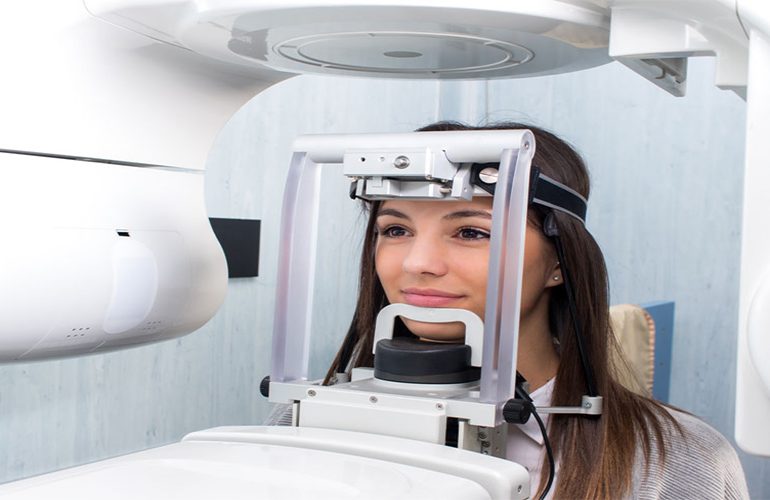
Canines are among the teeth with the longest eruption path in the mouth, and for this reason they may remain in the bone without completing their path. Families usually notice the situation as follows: the tooth that has erupted in peers never appears, or the baby canine does not fall out. In impacted canine cases, the most critical information is exactly where the tooth sits. As DijiDent Oral and Dental Health Polyclinic, in Türkiye we plan these cases after determining the position three-dimensionally.
Why Does a Canine Not Erupt?
- Lack of space: Insufficient space in the jaw for the tooth to erupt.
- Deviation of the eruption path: The tooth being initially oriented at the wrong angle.
- The baby tooth not falling out on time: The permanent tooth cannot advance because the path has not been cleared.
- Presence of an extra tooth or formation: A physical obstacle in the eruption path.
- Genetic predisposition: The frequency may increase in children with a family history.
Why Is Early Evaluation Important?
The most important risk of an impacted canine is that it presses on the root surfaces of the neighboring incisors and starts resorption there. This process progresses silently and causes no pain. By the time it is noticed, loss may have developed in the neighboring tooth. For this reason, orthodontic evaluation during the eruption period of permanent teeth in children is not just aesthetic planning; it aims to protect the neighboring teeth.
Why Is the Position So Decisive?
Whether the tooth has remained impacted on the lip side or the palate side changes the entire treatment. The direction from which surgical access will be made, the direction of the force to be applied and the treatment duration are determined accordingly. This distinction cannot always be made reliably on a two-dimensional film. Three-dimensional imaging also shows whether there is resorption in the root of the neighboring incisor; this finding directly affects the urgency of treatment.
A Warning About the Baby Canine
A baby canine not falling out at the expected age may seem like an insignificant delay on its own. However, this is one of the earliest signs that the permanent tooth beneath it cannot find its way. In addition, baby teeth are not designed for the chewing forces of permanent teeth; when used for years, they wear down and are eventually lost. For this reason, instead of the “it’s staying anyway” approach, evaluation of the position of the permanent tooth is recommended.
How Does Treatment Proceed?
Although the approach varies by case, the general flow is as follows:
- Creating space: Space in which the tooth can erupt is prepared with orthodontic treatment.
- Surgical exposure: The area over the tooth is opened in a controlled manner and a small attachment is bonded.
- Orthodontic traction: The tooth is gradually guided into the arch with light forces.
- Positioning and finishing: After the tooth is placed in line, the bite is arranged.
- Retention: A retention phase is applied to preserve the result.
This process requires patience; because the tooth moves through the bone, progress is slow. The duration varies significantly depending on the position of the tooth and the age of the patient.
Patient Compliance During Treatment
In these treatments, most of the result depends on patient compliance. Not missing check-up appointments, meticulously maintaining oral care and regularly using the appliances recommended by the dentist directly affect the process. Especially in adolescent patients, family support is decisive for maintaining motivation; regularly showing the progress helps in this respect.
Can the Tooth Be Saved in Every Case?
No, and this needs to be shared from the start. The tooth being in a very horizontal position, its root development being complete and fused with the bone, or advanced age can lower the expected success. In these cases, extraction and an implant in its place, or orthodontic space closure options are evaluated. The decision is made together, with the findings shared with you.
Frequently Asked Questions
An orthodontic evaluation is recommended during the period when permanent teeth start to erupt. The delay of a tooth that has erupted in peers is sufficient reason for a check-up.
In some cases, extracting the baby tooth can correct the direction of the permanent tooth. The decision is made after the position of the permanent tooth is seen.
It varies according to the position of the tooth and age; it is usually a long-term process. The exact duration is shared after evaluation.
It can; however, the expected success may change with age. A detailed evaluation is needed.
Implant, bridge or orthodontic space closure options are evaluated.
A tooth that does not erupt is not solved by waiting.
Let us evaluate the position of your child’s or your own canine three-dimensionally and discuss the treatment options. Contact us to book an appointment; let us carry out your orthodontic evaluation at DijiDent Oral and Dental Health Polyclinic.
This content is for general information purposes. The treatment method, duration and expected success vary from person to person; the decision is made with the dentist’s evaluation.