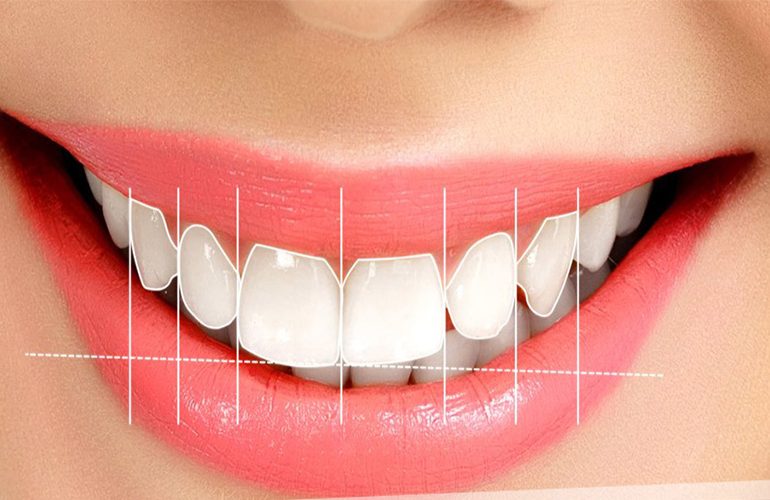
A common mistake in aesthetic dentistry is looking at the teeth only in isolation. However, teeth are not seen on their own but within a face. A technically flawlessly prepared restoration makes the smile look foreign if it does not harmonize with the facial proportions. Smile design facial analysis is therefore the first step of the design. As DijiDent Oral and Dental Health Polyclinic, in Türkiye we start planning not from the teeth but from the face.
Which References Are Used in the Analysis?
Facial Midline
The vertical line passing through the middle of the forehead, the tip of the nose and the tip of the chin is taken as a reference. The relationship of the junction line between the upper front teeth with this line is evaluated. There is an important detail: the eye is bothered less by a shift of the midline than by the teeth standing tilted on the vertical axis. For this reason, small shifts are not always corrected; what is decisive is upright alignment.
Horizontal Reference Lines
The line between the pupils forms a natural horizontal reference. The incisal edge line of the teeth being parallel to this line allows the smile to be perceived as balanced. Deviation from parallelism causes the smile to look crooked even if there is no problem among the teeth.
Balance of Facial Heights
The face is generally evaluated by dividing it into three horizontal sections. The proportion of the lower section is directly related to tooth lengths and bite height. Tooth length lost due to wear can, over time, contribute to shortening of the lower third of the face.
Profile and Lip Support
Viewed from the side, the support the upper lip receives is related to the position of the front teeth. Teeth positioned backward can reduce lip support; this is a criterion connected not only to aesthetics but also to speech and facial expression.
On the Expectation of Symmetry
No face is perfectly symmetrical, and this is not a flaw. Eyebrow heights, eye sizes and lip corners differ in most people. In the design, the goal is not to establish absolute symmetry but to bring the teeth into harmony with the existing facial balance. When a perfectly symmetrical dental arch is placed in an asymmetrical face, the result can be perceived as artificial. For this reason, slight asymmetries are deliberately preserved at our clinic.
Bringing a Reference Photo
Sharing a smile you like is valuable; it makes your expectations concrete. However, it is necessary to be realistic here: another person’s smile has been shaped according to that person’s facial proportions, lip structure and gum level. The same tooth form will look different on your face. We evaluate the reference not as “I want exactly this” but as “I like a look in this direction.” Describing which feature you like — the whiteness, the length or the form — is the most useful information.
Skin Tone and the Shade Decision
An overlooked dimension of facial analysis is color harmony. Tooth color is perceived not on its own but together with your skin tone and the whites of your eyes. In darker skin tones, teeth tend to look whiter; the same shade guide value is perceived differently in different people. For this reason, the shade should be chosen not by looking at a catalog but by evaluating it together with your face and in natural light.
How Are the Records Taken?
Facial analysis requires photographs taken under standard conditions: rest, a slight smile, a full smile and profile images. In addition, a video recording is taken to observe lip movement during speaking and laughing. When these records are aligned with the digital model data, the design is no longer an abstract drawing but a plan fitted to your face.
Is Analysis Needed in Every Case?
A comprehensive facial analysis is not needed for a single posterior tooth restoration. However, this step should not be skipped in treatments involving the front region, covering more than one tooth or in which tooth length will change.
Frequently Asked Questions
Yes. Profile records are taken to evaluate lip support and tooth position.
No. Small shifts often go unnoticed; what is decisive is the upright alignment of the teeth.
No. The design is planned by adapting it to the existing facial balance.
References show the direction; however, the result is adapted to your facial proportions.
Standard angles and lighting are necessary for a comparable and reliable analysis.
Taking the records is usually completed in a single session.
Your smile should belong to your face.
Contact us to book an appointment to have a design prepared that suits your facial proportions. Let us start planning from the right place at DijiDent Oral and Dental Health Polyclinic.
This content is for general information purposes; aesthetic results vary from person to person. Planning is done with a dentist’s examination.