After the bone fusion stage of implant treatment is complete, it is time to prepare the superstructure that will be visible in the mouth and take on the chewing function. Implant-supported prostheses offer different options according to the connection type, the material used and the number of missing teeth. These options directly affect both the aesthetic result and the ease of long-term care. Knowing the types of implant-supported prostheses makes it easier for you to decide on the solution most suitable for you together with your dentist. As DijiDent Oral and Dental Health Polyclinic, we prepare superstructures for our patients in Türkiye with digital design and production technologies.
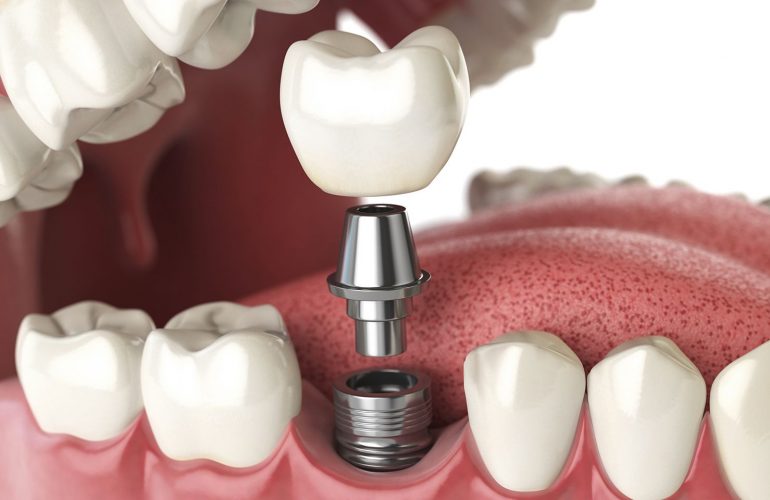
Components of the Superstructure
Abutment (Connecting Part)
The abutment is the part that provides the connection between the implant and the crown. While ready-made (standard) abutments can be used in many cases, custom-designed abutments are produced according to the shape of the gum and the angle of the implant and can provide more harmonious results, especially in aesthetic regions. Abutments can be made of materials such as titanium or zirconia.
Crown or Bridge
This is the part of the tooth visible in the mouth. A single crown can be made for a single implant, and a bridge for more than one implant.
Types of Prostheses by Connection Type
Screw-Retained Prostheses
The crown or bridge is fixed directly to the implant or the abutment by means of a screw. The screw access is usually located on the chewing surface or the tongue side of the tooth and is covered with a tooth-colored filling.
- Removability: It can easily be removed by the dentist when necessary; care, repair and check-ups become easier.
- No risk of cement residue: The risk of inflammation that could be caused by cement residue remaining under the gum is eliminated.
- Limitations: The position of the screw access may affect aesthetic planning depending on the angle of the implant.
Cemented Prostheses
The crown is cemented onto the abutment screwed to the implant, in a way similar to a crown on a natural tooth. There is no screw access on the chewing surface.
- Aesthetics: Since there is no screw access, it provides an uninterrupted surface.
- Application: It has a workflow similar to natural tooth crowns.
- Limitations: It is more difficult to remove, and cement residue remaining under the gum can increase the risk of inflammation; for this reason, it requires meticulous cleaning.
Today, in suitable cases, screw-retained prostheses are frequently preferred because of their ease of care and the absence of the risk of cement residue. The choice is made according to the position of the implant, aesthetic requirements and the characteristics of the case.
Material Options
- Monolithic zirconia: Because of its high durability, it can be preferred especially in the back region and for patients with a teeth-clenching habit.
- Porcelain on a zirconia framework: It provides a natural appearance with aesthetic layering; it is frequently preferred in the front region.
- All-ceramic (for example, lithium disilicate): With its high light transmission, it offers aesthetic results, especially in the front region.
- Porcelain fused to metal: A durable option that has been used for a long time.
- Composite or acrylic: Generally used in temporary prostheses or in some full-arch solutions.
The choice of material is made according to the aesthetic importance of the region, chewing forces and the structure of the teeth in the opposing jaw.
Types of Prostheses by Number of Missing Teeth
- Single crown: Made on one implant for a single missing tooth.
- Implant-supported bridge: For more than one missing tooth, a bridge can be made on fewer implants instead of one implant per tooth.
- Full-arch fixed prosthesis: A fixed prosthesis screwed onto several implants in jaws where all teeth are missing.
- Implant-supported removable denture: A denture attached to the implants with attachments or a bar system, which can be removed by the patient.
Why Does an Implant Tooth Loosen?
With screw-retained prostheses, screw loosening may be seen over time. Its causes include bite imbalances, teeth clenching, excessive loads and incompatibility of components. When loosening is noticed, the clinic should be contacted without losing time; because a loose prosthesis can lead to damage to the implant components and plaque accumulation. In most cases, the problem can be solved by retightening the screw and adjusting the bite.
Bite and Night Guard
Since implants do not have a connective tissue that provides slight flexibility as in natural teeth, they transmit chewing forces directly to the bone. For this reason, careful adjustment of the bite of the superstructure protects the implant and prosthesis components from excessive loads. For patients with a clenching or grinding habit, a night guard may be recommended to prevent problems such as porcelain fractures and screw loosening. Re-evaluating the bite at check-ups also contributes to long-term success.
Digital Design and Production
At DijiDent, we design implant-supported prostheses with digital impressions taken with an intraoral scanner and CAD/CAM technology. This approach supports the precise fit of the prosthesis with the implant, correct planning of the bite and advance evaluation of color and form harmony. During the design stage, we also treat cleanability as an important criterion.
Frequently Asked Questions
Both have advantages. Screw-retained prostheses provide ease of care; the choice is made according to the case.
It is the part that provides the connection between the implant and the upper prosthesis.
There are options such as zirconia, all-ceramic and porcelain fused to metal; the choice is made according to the region and expectations.
Contact the clinic. The problem is usually resolved by retightening the screw and adjusting the bite.
Ceramic materials have high color stability; acrylics and composites may discolor over time.
A strong foundation is completed with a correctly designed superstructure.
Contact us to book an appointment to determine the upper prosthesis option most suitable for your implants. Let us design your new teeth digitally together at DijiDent Oral and Dental Health Polyclinic.
This content is for general information purposes and does not replace an examination by a dentist. The prosthesis type and material choice are recommended by the dentist after clinical evaluation.