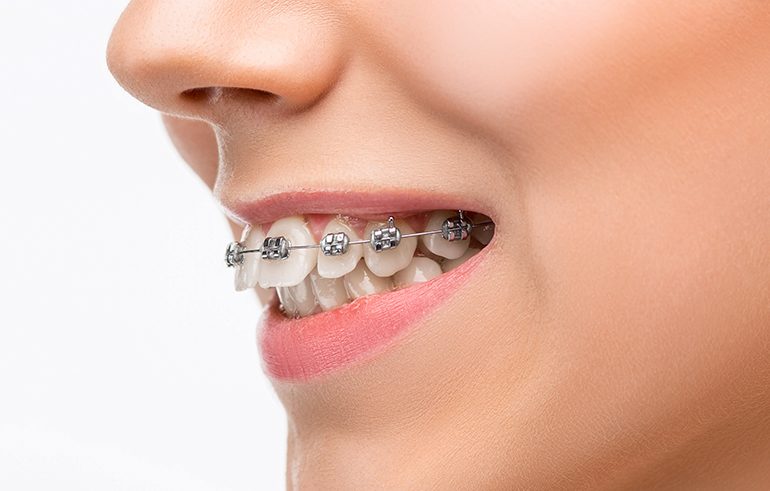
In many patients aiming for an aesthetic smile, the problem is not in a single area. The position of the teeth may be off while their form is also not suitable; or there may be missing teeth while the gum levels are irregular. In these cases, it is not possible to achieve a result with a single treatment. Combining orthodontics and aesthetic treatment, when applied in the right sequence, provides a result that is both more conservative and more lasting. As DijiDent Oral and Dental Health Polyclinic, in Türkiye we set up this planning holistically from the start.
The Basic Principle: Position First, Then Form
Where a tooth stands and how it looks are different problems and require different solutions. Trying to solve a position problem with a change of form leads to more structure being removed from the tooth than necessary.
Let us look at an example: to make a front tooth that sits further back appear aligned with the others, either the tooth is moved forward orthodontically or a thick restoration is made on it. In the second option, structure is removed from the front surface so that the tooth does not look thick; yet a tooth that is already set back has no excess to remove. As a result, the living tissue may be approached.
When Is Orthodontics Unavoidable?
- If there is pronounced crowding or malposition of the teeth
- If there is a bite problem; restorations remain under unbalanced load
- If the gum levels are irregular due to the vertical position of the teeth
- If the gaps are too wide to be closed restoratively
- If the neighboring teeth of a missing tooth area have tilted or the opposing tooth has elongated
When Is Orthodontics Not Enough?
Orthodontics moves the teeth; however, it does not restore their color, form or lost tissue. Worn incisal edges, permanent discoloration, broken teeth and size mismatches require a restorative approach. For this reason, in some cases the two areas complement each other: orthodontics prepares the foundation, restorative treatment completes it.
The Right Sequence
In combined plans, the sequence directly affects the result:
- Oral health: Caries and gum treatments are completed.
- Orthodontic alignment: The teeth and bite are brought into the correct position.
- Gum contouring: If necessary, the level is adjusted and healing is awaited.
- Whitening: The target color is determined and allowed to settle.
- Restorative applications: Composite, laminates or crowns are made.
- Retention: The orthodontic result is preserved.
It is mandatory for whitening to be done before restoration, because porcelain and composite are not affected by whitening. When the sequence is disrupted, a permanent shade difference forms.
Orthodontic Space Management
In some cases, the aim of orthodontics is not to close the gap but to leave space in the right place and in the right amount. In a patient congenitally missing a lateral incisor, an area of suitable width must be created for an implant. If this area is too narrow or too wide, the restoration done afterwards looks disproportionate. For this reason, the orthodontist and the restorative dentist need to work on the same plan.
Orthodontics for Gum Level
This is a little-known area of application. If a tooth’s gum level differs from its neighbors, this sometimes results from the vertical position of the tooth. Moving the tooth down or up orthodontically moves the gum along with it. In this way, the level can be corrected without the need for surgical intervention.
A Special Situation in Worn Teeth
In patients whose front teeth have shortened due to teeth clenching, doing only restoration is often not enough. Vertical space between the teeth is needed to restore the lost length; if this space does not exist, the restoration either remains too thin or strains the bite. In these cases, positioning the teeth orthodontically creates space for the restorative work. Otherwise, the restorations made may break in a short time.
The Concern About Duration
Most patients see the orthodontic stage as an unnecessary delay and want restoration directly. We respect this preference; however, we openly share its consequences: restorations made without correcting the position may mean more loss of tooth tissue and may create the need for renewal in the long term. The decision is yours, but it should be made with information.
Frequently Asked Questions
It is possible in some cases; however, it may require more reduction. An evaluation is recommended.
No. In many cases, no additional procedure is needed after alignment.
A short wait may be planned for gum healing and stabilization.
Tilted neighboring teeth and an elongated opposing tooth may narrow the area suitable for an implant.
Different dentists may be involved; what matters is that they work on the same plan.
An aesthetic result is achieved in the right order.
Let us evaluate holistically which stages are needed in your case. Contact us to book an appointment; let us set up your plan together at DijiDent Oral and Dental Health Polyclinic.
This content is for general information purposes. The treatment plan and its sequence are determined by your dentist after the clinical evaluation.