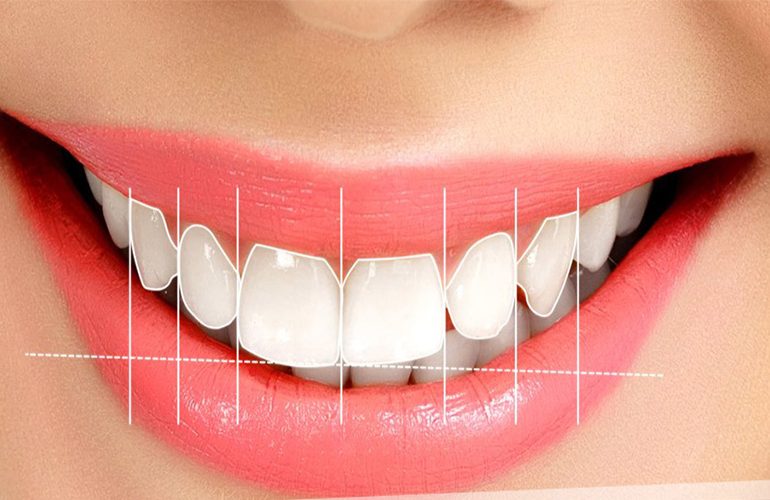
Many people looking at their photographs notice that the line between their front teeth does not exactly coincide with the middle of their face and perceive this as a flaw. However, what is decisive in aesthetic perception is often different from what is assumed. When dental midline evaluation is done with the right criteria, it allows many patients to avoid unnecessary treatment. As DijiDent Oral and Dental Health Polyclinic, in Türkiye we address this topic in detail before making an intervention decision.
First, a Fact: Small Deviations Go Unnoticed
There is a recurring finding in aesthetic research: observers often do not notice small horizontal shifts in the dental midline. On the other hand, the same observers detect the teeth standing tilted on the vertical axis much more easily. In other words, the eye is more sensitive to tilt than to shift.
The practical consequence of this is: a limited midline shift may not be a reason for treatment on its own. However, if the teeth stand tilted on the vertical axis, this creates a more pronounced aesthetic effect and its correction takes priority.
Which Should Be the Reference?
In the evaluation, the dental midline is compared with the facial midline. The line passing through the middle of the forehead, the tip of the nose and the tip of the chin is taken as a reference. There is a point to note here: the facial midline cannot always be clearly determined, because no face is perfectly symmetrical. The tip of the nose may be slightly shifted. For this reason, several references are looked at together rather than a single point.
Causes of Deviation
- Tooth-related: Lack of space, tooth size differences or malposition of the teeth.
- Missing teeth: Neighboring teeth shifting into the gap of a tooth lost early.
- Early loss of baby teeth: A space maintainer not having been used in childhood.
- Skeletal: Asymmetric development of the upper or lower jaw.
- Functional: The jaw shifting to one side when closing.
If the cause is different, the solution is different. While a tooth-related deviation can be corrected orthodontically, a pronounced asymmetry of skeletal origin cannot be eliminated by moving the teeth alone.
Solution Options
Orthodontic Correction
It is the most conservative method for tooth-related deviations. The midline is corrected with gradual movement without preparing the teeth. It takes time; however, tooth tissue is preserved.
Restorative Camouflage
In limited deviations, it may be possible to balance perception by adjusting the visible widths of the teeth. This approach, done with composite or porcelain applications, does not change the actual position; it manages perception. If the deviation is large, this method is insufficient and, when forced, the teeth may look disproportionate.
Combined Approach
After the deviation is reduced with limited orthodontic movement, restorative fine-tuning can be done. In practice, this is the most frequently preferred path.
Surgical Support
In pronounced asymmetries of skeletal origin, jaw surgery planned together with orthodontics may come into consideration. This is a comprehensive process and is recommended only in selected cases.
Distinguishing the Upper and Lower Midlines
In the evaluation, the midlines of the upper and lower jaws are considered separately. From an aesthetic point of view, what is really decisive is the upper midline, because it is the area most visible when smiling. Deviations in the lower midline are much less noticeable in everyday appearance. For this reason, in some plans only the upper midline is targeted and a limited deviation in the lower jaw is preserved; this is not a shortcoming but a choice to avoid unnecessary treatment.
Should It Be Corrected or Not?
When making the decision, we answer these questions together: is the deviation really noticeable, are the teeth tilted on the vertical axis, is there a functional problem, and are you bothered by it? It is not right to recommend treatment just because a technical measurement shows deviation. Avoiding unnecessary intervention is also part of clinical responsibility.
Frequently Asked Questions
No. Small deviations often go unnoticed and may not require treatment.
In limited deviations, perception can be balanced; in pronounced deviations it is insufficient.
If there is a skeletal component, orthodontics alone may not eliminate it completely. This should be discussed at the start of treatment.
An orthodontic evaluation is recommended. Simpler approaches may be possible at an early stage.
Yes. Neighboring teeth can shift into gaps over time; for this reason, missing teeth should not be left untreated.
Not every deviation requires treatment; it requires the right evaluation.
Let us determine together the source of the disharmony in your smile and whether intervention is really needed. Contact us to book an appointment; let us discuss your options at DijiDent Oral and Dental Health Polyclinic.
This content is for general information purposes; the treatment option and results vary from person to person. The decision is made with a dentist’s examination.