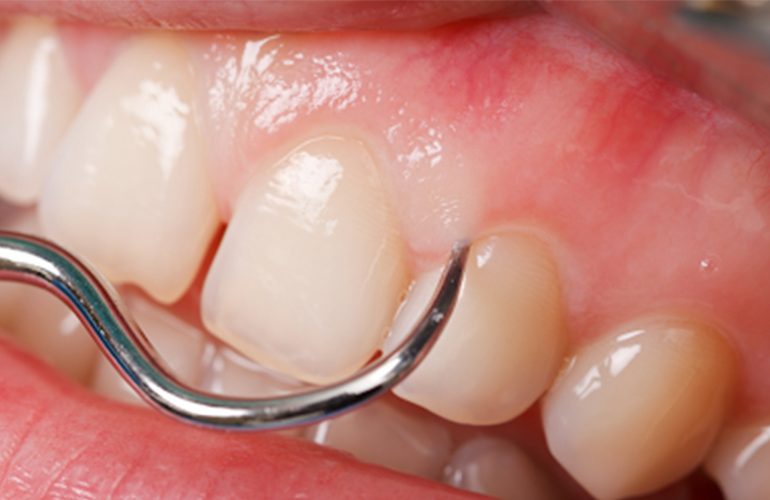
Bone lost in periodontal disease does not come back on its own. However, in certain types of cases, applications have been developed to regain part of the lost support. Gum bone grafting and tissue regeneration approaches serve this purpose. As DijiDent Oral and Dental Health Polyclinic, in Türkiye we recommend these applications with realistic expectations and in suitable cases.
Why Can Not Every Loss Be Repaired?
This is the issue that needs to be clarified first. The shape of the bone loss directly determines the result. If the loss is in the form of a narrow and deep pit around the tooth, the remaining bone walls provide support for regeneration and the likelihood of gain increases. On the other hand, if the loss has progressed horizontally over a wide area, no walls remain to support regeneration and the expectation of gain in such cases is low.
For this reason, the approach “my bone has resorbed, let’s do a graft” is not always applicable. Suitability is determined according to the radiological evaluation and the bone structure seen during surgery.
Materials Used
Graft materials are obtained from different sources. Materials taken from the patient’s own bone, processed materials of human origin, processed materials of animal origin and completely synthetic materials can be used. Each has different advantages and areas of use.
Most materials are not a substance that turns directly into bone. Their task is to preserve the space during the healing process and to allow the body’s own cells to settle in this area and form new tissue. In other words, the graft acts as a scaffold.
Membrane Use
During healing, gum tissue proliferates faster than bone tissue. If no precaution is taken, this tissue fills the space and no room is left for bone formation. For this reason, membranes that act as a barrier are placed over the graft. Membranes protect the space and give time for the correct tissue to form. Some membranes dissolve on their own; some are removed after a certain period.
How Does the Process Work?
The application is carried out as part of a surgical procedure. The gum is lifted, the root surface and bone defect are cleaned, the graft material is placed and a membrane is applied if necessary. The tissue is then closed with stitches.
Healing takes months. During this period, protecting the area is critically important: it must not be brushed for the specified period, hard foods must be avoided and check-ups must be attended regularly. Excessive force applied in the early period may disrupt the tissue that is forming.
How Is the Result Evaluated?
The gain is evaluated with radiographs and pocket measurements taken after a certain period. The goal is a reduction in pocket depth, the stopping of bleeding and radiological improvement in the bone level.
It is necessary to be realistic here: regaining all of the lost bone is not possible in most cases. Even partial gain can extend the life of the tooth, and this is considered a success of the treatment. We recommend that you approach with caution approaches that promise full gain.
Factors Affecting Success
- The shape of the defect: The number of remaining bone walls is the most decisive factor.
- Control of inflammation: Application done while there is active inflammation fails.
- Oral care: It is decisive during and after the healing period.
- Smoking: It is the most important modifiable factor that negatively affects tissue response.
- Systemic conditions: Uncontrolled diabetes can make healing more difficult.
- Tooth mobility: In loose teeth, protecting the space is difficult.
Platelet-Rich Products
In some applications, products obtained from the patient’s own blood and aimed at supporting healing can be used together with the graft material. This approach is considered with the aim of contributing to the tissue healing process. It is not necessary in every case and does not create bone on its own; it should be considered a supportive component.
The Difference from Grafting for Implants
Patients often confuse these two applications. In grafting done before an implant, the aim is to create the bone volume that will carry the implant. In periodontal grafting, the aim is to repair the loss around an existing tooth. Although the techniques are similar, the aim and the success criteria are different.
Frequently Asked Questions
In most cases full gain is not expected; partial gain can extend the life of the tooth.
No. The shape of the defect determines suitability.
It is done under local anesthesia; afterwards there may be tenderness for a few days.
It takes months; the evaluation is done after a certain period.
Alternative plans are evaluated; this possibility is shared from the start.
Part of the lost support can be repaired.
Let us evaluate whether your case is suitable for these applications. Contact us to book an appointment; let us discuss your options at DijiDent Oral and Dental Health Polyclinic.
This content is for general information purposes. The decision to apply it and the expected gain are determined by clinical and radiological evaluation; no guarantee of results can be given.